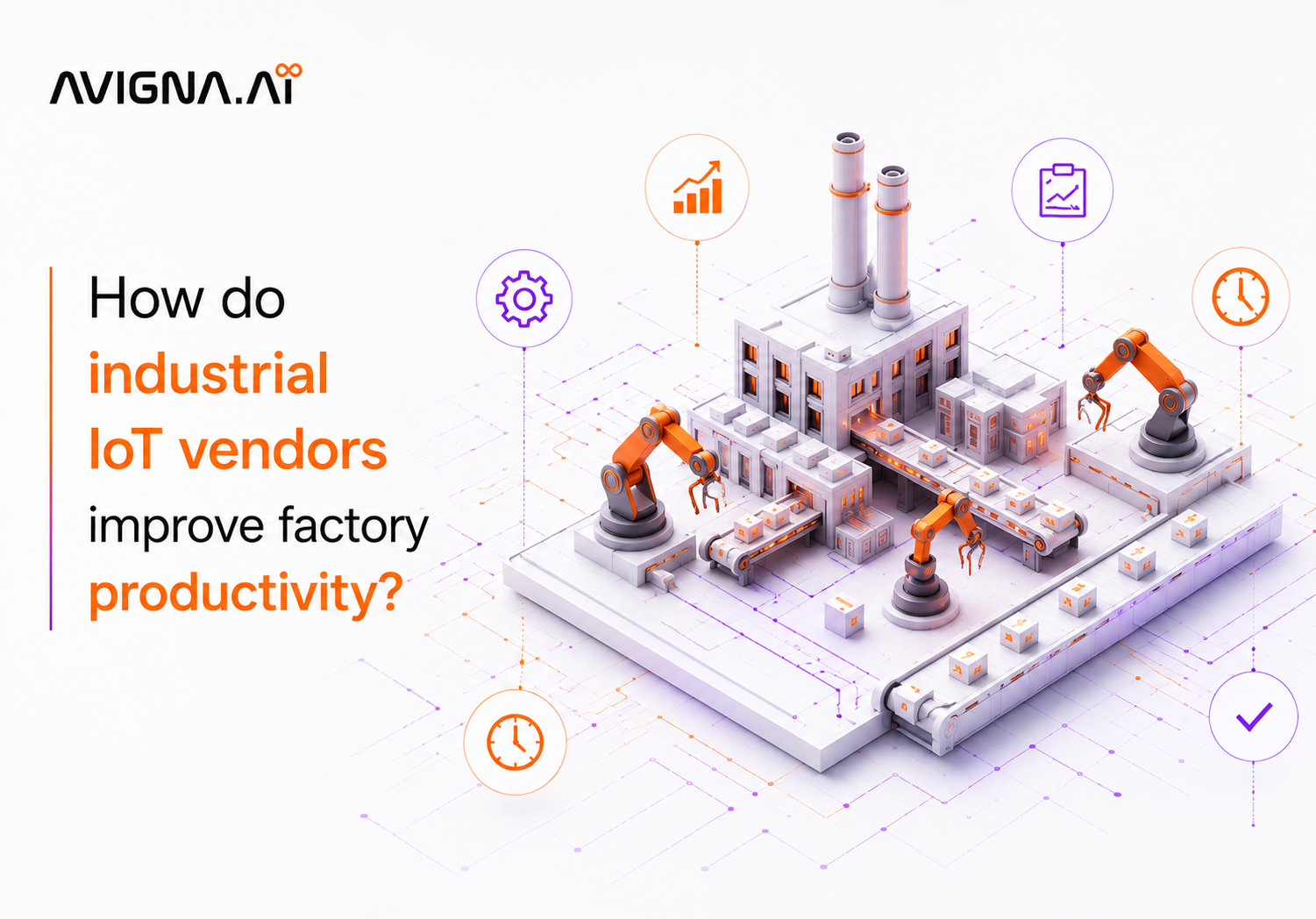
How Do Industrial IoT Vendors Improve Factory Productivity?
Modern manufacturing facilities generate enormous volumes of operational data every second.
Machines produce telemetry. Sensors track movement. Production lines create performance metrics. Warehouses monitor inventory flows. Energy systems continuously report consumption patterns.
Yet many factories still struggle with:
- Unplanned downtime
- Production inefficiencies
- Limited operational visibility
- Rising maintenance costs
- Manual reporting processes
- Quality inconsistencies
The issue is rarely a lack of data.
The issue is the inability to convert operational data into actionable intelligence.
This is where Industrial IoT vendors are reshaping manufacturing operations.
By integrating connected sensors, intelligent automation, edge computing, AI-driven analytics, and real-time monitoring systems, Industrial IoT (IIoT) vendors help manufacturers improve productivity, reduce operational inefficiencies, and build more adaptive production environments.
According to McKinsey, smart factory technologies can improve manufacturing productivity by up to 30% while significantly reducing machine downtime and quality-related losses.
For enterprises navigating increasing global competition, labor shortages, and supply chain volatility, Industrial IoT is rapidly becoming a strategic operational necessity.
What Is Industrial IoT?
Industrial IoT refers to the use of connected sensors, devices, machines, and software platforms within industrial environments to collect, exchange, and analyze operational data in real time.
Unlike consumer IoT applications, Industrial IoT focuses on:
- Manufacturing operations
- Industrial automation
- Supply chain systems
- Predictive maintenance
- Production optimization
- Asset management
- Energy monitoring
Industrial IoT environments typically combine:
- Sensors
- PLCs
- SCADA systems
- Edge devices
- Cloud platforms
- AI and analytics engines
Why Factory Productivity Has Become a Strategic Priority
Manufacturers today face simultaneous operational pressures:
- Increasing production demands
- Higher customer expectations
- Energy cost fluctuations
- Skilled labor shortages
- Equipment reliability challenges
- Supply chain uncertainty
Traditional operational models often rely on reactive decision-making.
Industrial IoT shifts manufacturing toward:
- Predictive operations
- Real-time visibility
- Automated workflows
- Data-driven optimization
As factories become increasingly digitized, productivity improvements are no longer achieved through isolated automation initiatives alone.
They are achieved through connected operational ecosystems.
7 Ways Industrial IoT Vendors Improve Factory Productivity
1. Reducing Unplanned Downtime Through Predictive Maintenance
Unexpected machine failures remain one of the largest causes of manufacturing productivity loss.
Industrial IoT vendors address this challenge through predictive maintenance systems powered by:
- Vibration sensors
- Temperature monitoring
- Machine telemetry
- AI-driven analytics
Instead of waiting for equipment failure, manufacturers can identify performance anomalies before breakdowns occur.
This enables:
- Scheduled maintenance planning
- Reduced production interruptions
- Lower maintenance costs
- Extended equipment lifespan
Typical Business Impact
| Operational Area | Improvement |
| Downtime Reduction | 20–40% |
| Maintenance Cost Reduction | 10–30% |
| Equipment Lifespan | Increased operational longevity |
2. Enabling Real-Time Production Visibility
Many factories still rely on delayed reporting systems that limit operational responsiveness.
Industrial IoT platforms provide live production monitoring across:
- Machines
- Assembly lines
- Warehouses
- Utilities
- Logistics systems
Real-time dashboards allow decision-makers to monitor:
- Throughput
- OEE (Overall Equipment Effectiveness)
- Production bottlenecks
- Machine utilization
- Process anomalies
This visibility improves operational agility and accelerates issue resolution.
3. Improving Quality Control Through Intelligent Monitoring
Quality inconsistencies can create substantial financial losses across manufacturing operations.
Industrial IoT vendors integrate:
- Vision systems
- AI-based inspection tools
- Environmental monitoring
- Sensor-driven validation systems
These technologies help manufacturers identify defects earlier in the production cycle.
As a result:
- Scrap rates decrease
- Rework costs decline
- Product consistency improves
- Compliance reporting becomes easier
In advanced AIoT environments, machine learning models can continuously improve inspection accuracy over time.
4. Optimizing Energy Consumption
Industrial facilities are among the highest energy-consuming environments globally.
Industrial IoT systems monitor:
- Energy usage patterns
- Equipment efficiency
- Utility consumption
- Peak load behavior
Connected energy intelligence platforms help enterprises:
- Reduce operational waste
- Improve sustainability metrics
- Optimize power distribution
- Lower utility costs
For energy-intensive industries, these savings can become operationally significant at scale.
5. Enhancing Asset Tracking and Inventory Visibility
Disconnected inventory systems often create:
- Delays
- Overstocking
- Material shortages
- Production inefficiencies
Industrial IoT vendors improve asset visibility using:
- RFID systems
- Smart sensors
- Real-time location tracking
- Warehouse automation
Connected inventory intelligence enables:
- Faster material movement
- Improved warehouse accuracy
- Better production planning
- Reduced operational delays
This becomes especially important in large-scale manufacturing and logistics environments.
6. Supporting Faster Decision-Making With AI Analytics
Industrial IoT platforms generate enormous amounts of operational data.
Without advanced analytics, much of this data remains underutilized.
Modern IIoT vendors integrate AI and machine learning capabilities that help enterprises:
- Detect patterns
- Forecast operational risks
- Optimize production schedules
- Improve resource allocation
- Predict operational inefficiencies
This transforms factories from reactive environments into intelligent operational systems capable of continuous optimization.
7. Enabling Scalable Smart Factory Transformation
Industrial IoT is not limited to individual machines or isolated use cases.
Leading vendors help manufacturers build scalable digital ecosystems that connect:
- Production systems
- ERP platforms
- Supply chain operations
- Cloud infrastructure
- AI systems
- Enterprise analytics platforms
This integration enables organizations to scale digital transformation initiatives across multiple facilities and regions.
What Productivity Gains Do Manufacturers Typically Achieve with IoT?
The operational impact of Industrial IoT varies based on deployment maturity, industry, and integration depth.
However, enterprises commonly report measurable improvements across multiple performance indicators.
| Industrial IoT Use Case | Typical Outcome |
| Predictive Maintenance | Reduced downtime |
| Real-Time Monitoring | Faster issue resolution |
| AI Quality Inspection | Lower defect rates |
| Energy Intelligence | Reduced utility costs |
| Asset Tracking | Improved inventory accuracy |
| Smart Automation | Increased production efficiency |
As AI capabilities mature, productivity improvements are expected to become even more significant across industrial operations.
Why Vendor Selection Matters in Industrial IoT
Industrial IoT deployments involve far more than device installation.
Successful implementation requires:
- OT expertise
- Cloud integration capability
- AI and analytics maturity
- Industrial cybersecurity
- Scalability planning
- Enterprise interoperability
The wrong implementation strategy can create fragmented systems that limit long-term value realization.
This is why enterprises increasingly prioritize strategic technology partners capable of supporting both operational modernization and long-term digital transformation.
The Future of Factory Productivity Is Connected Intelligence
The next generation of manufacturing will not be defined solely by automation.
It will be defined by intelligent, connected, self-optimizing operations.
Industrial IoT is becoming the foundation for:
- Autonomous factories
- AI-driven manufacturing
- Predictive operations
- Connected supply chains
- Intelligent asset ecosystems
As manufacturing environments become more data-intensive, organizations that successfully operationalize industrial intelligence will gain significant competitive advantages in efficiency, agility, and scalability.
How Avigna.AI Supports Industrial IoT Transformation
Avigna AI helps enterprises modernize manufacturing and industrial operations through scalable AIoT and Industrial IoT solutions designed for real-world operational environments.
By combining expertise across:
- Industrial automation
- AI integration
- Edge computing
- Cloud platforms
- Operational intelligence
- Enterprise connectivity
Avigna AI enables organizations to build connected manufacturing ecosystems that improve visibility, productivity, and operational resilience.
The company’s approach focuses on delivering:
- Intelligent monitoring systems
- Real-time operational visibility
- AI-driven analytics
- Secure edge-to-cloud infrastructure
- Scalable industrial transformation strategies
With growing demand for smarter and more adaptive industrial operations, enterprises increasingly require technology partners capable of aligning operational technology with long-term business transformation goals.
Final Thoughts
Factory productivity is no longer driven solely by labor efficiency or equipment capacity.
It is increasingly driven by operational intelligence.
Industrial IoT vendors help manufacturers unlock this intelligence by connecting machines, systems, data, and decision-making processes into unified digital ecosystems.
For enterprises pursuing smart manufacturing initiatives, the value of Industrial IoT extends beyond automation.
It enables:
- Faster decisions
- Predictive operations
- Greater operational resilience
- Scalable manufacturing transformation
As industrial competition accelerates globally, connected factories will increasingly become the standard rather than the exception. Schedule your free Industrial IoT consultation call with us.
Frequently Asked Questions
What is Industrial IoT in manufacturing?
Industrial IoT refers to connected devices, sensors, machines, and software systems used to monitor, analyze, and optimize industrial operations in real time.
How does Industrial IoT improve factory productivity?
Industrial IoT improves productivity through predictive maintenance, real-time monitoring, AI analytics, energy optimization, automated quality control, and connected operational intelligence.
What industries benefit most from Industrial IoT?
Industries such as manufacturing, automotive, logistics, energy, pharmaceuticals, healthcare, and supply chain operations commonly benefit from Industrial IoT deployments.
What is predictive maintenance in Industrial IoT?
Predictive maintenance uses sensors and analytics to identify equipment issues before failures occur, helping manufacturers reduce downtime and maintenance costs.
Why is AI important in Industrial IoT?
AI helps industrial systems analyze operational data, identify patterns, forecast failures, automate decisions, and optimize manufacturing performance at scale.