AvignaTechnicianCoPilot™: Transforming Field Service and Maintenance
The most valuable knowledge in an industrial service organization is often distributed across people, manuals, service records and equipment history.
A technician may know how to resolve a recurring fault. A manual may contain the correct procedure. A service record may reveal that the same component failed under similar conditions. A photograph may provide the missing clue.
The operational challenge is bringing these sources together at the moment a technician needs them.
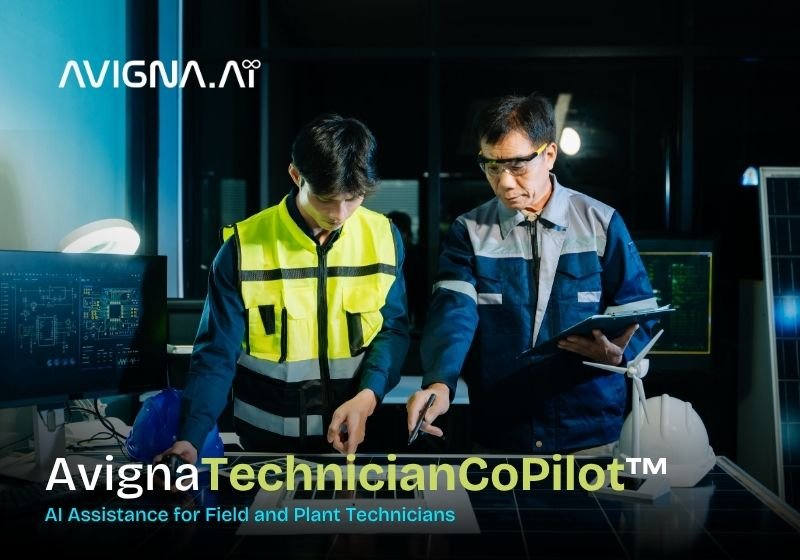
AvignaTechnicianCoPilot™ is a mobile AI copilot for field and plant technicians that places AvignaCube’s knowledge graph, telemetry and generative AI into a conversational application. It is designed to support troubleshooting, documentation lookup, visual diagnostics, guided repair and digital service logging.
“The future of field service is not a technician working alone with a manual, but a technician equipped with the context, intelligence and knowledge needed to resolve the problem in front of them.”
The Problem Behind Slow Field Service
Field service operations often depend on the availability of experienced technicians.
When experienced personnel retire or leave, valuable operational knowledge can leave with them. Newer technicians may need to search through PDFs, consult senior colleagues or rely on incomplete information to resolve a fault.
The problem extends beyond troubleshooting.
Service records may be written after the work is completed, if they are written at all. Resolution quality can vary by technician experience. Equipment history, warranty status and parts information may exist in separate systems.
AvignaTechnicianCoPilot is designed to address these issues through a shared AI-enabled service experience. Its purpose is to bring relevant technical information and equipment context into one conversational application rather than requiring technicians to work across a manual, portal and notebook.
What Is an AI Copilot for Field Service?
An AI copilot for field service is useful only when it understands the operational context of the task.
A generic chatbot may provide an answer about equipment maintenance. A context-aware service copilot should be able to work with the asset’s history, current telemetry, technical documentation and service records.
AvignaTechnicianCoPilot is grounded in AvignaCube’s knowledge graph.
This allows the application to combine live telemetry, asset history and connected technical information when supporting troubleshooting. It is designed to guide technicians through fault diagnosis rather than simply present a static decision tree.
The distinction is between retrieving information and helping a technician use that information to resolve a problem.
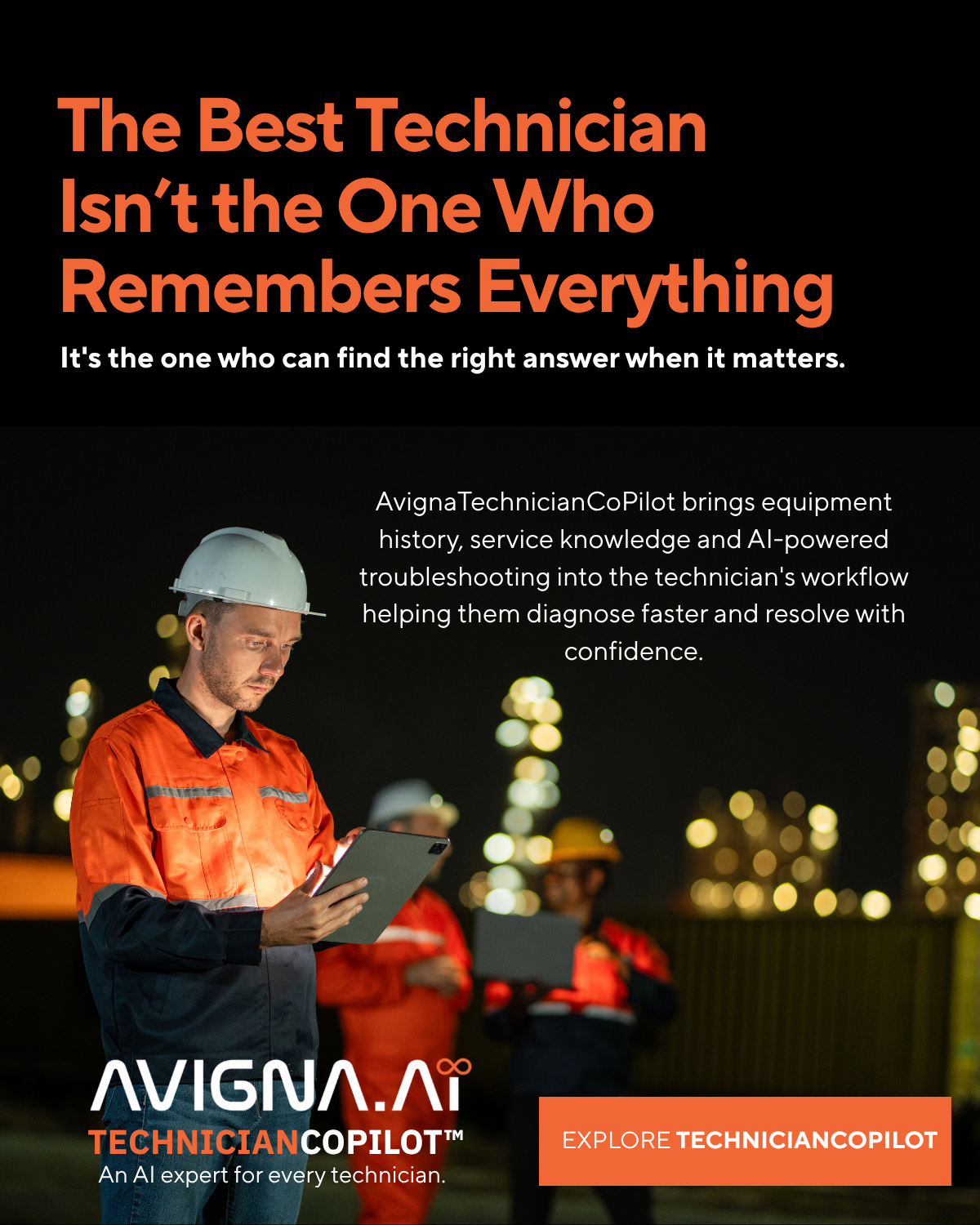
Conversational Troubleshooting and Technical Knowledge
The product’s core workflows address several stages of field service.
Conversational Troubleshooting
Technicians can use natural-language fault diagnosis that combines live telemetry, asset history and the knowledge graph to guide them towards root cause.
Manual and SOP Search
Retrieval-augmented generation provides cited answers from manuals, SOPs and service bulletins. The workflow also supports multilingual technical information for global technician workforces.
Photo and Video-Based Lookup
A technician can photograph a nameplate, part or error screen. Azure AI Vision and multimodal models can identify the asset, retrieve specifications and service history, and flag visible defects.
Context-Aware Copilot Chat
The application can provide assistance using information such as asset history, open work orders and warranty status, reducing the need for technicians to re-explain the situation.
These workflows are designed to bring the information required for service decisions into the technician’s immediate working context.
From Troubleshooting to Guided Repair
A service copilot becomes more useful when it supports the next action.
AvignaTechnicianCoPilot includes guided repair procedures generated and grounded from technical manuals. These procedures are structured for future AR overlay.
The platform also supports parts identification and ordering assistance. Visual parts lookup can generate parts requests routed into the OEM’s ERP or parts system.
This creates a more connected service workflow.
A technician can investigate a fault, retrieve the relevant procedure, identify the required part and initiate the appropriate request. The objective is to reduce the fragmentation that often exists between diagnosis, repair and service administration.
The blueprint also identifies access to full asset service history, including parts replaced, prior faults and warranty status.
Digital Service Logging Without the Paperwork Burden
Field service documentation is often treated as an administrative task. In practice, it is part of the organization’s operational knowledge.
When service notes are delayed or incomplete, the organization loses information that could improve future diagnosis and maintenance decisions.
AvignaTechnicianCoPilot supports voice-to-text field notes that are automatically structured into service records, with photo attachments and geotagging.
This allows technicians to capture information as part of the service workflow rather than reconstructing the work afterwards.
The platform’s knowledge capture loop extends this further. Every technician resolution feeds back into the AvignaCube knowledge graph, creating a continuously improving source of diagnostic knowledge for the wider technician workforce.
Why the Knowledge Graph Matters
The knowledge graph is a central part of the product’s architecture.
It provides the shared foundation through which equipment, faults, procedures and service information can be connected.
A technician may encounter a fault that resembles a previous incident. The relevant answer may depend on the asset model, its service history, the procedure associated with the component and the actions taken during earlier repairs.
A connected knowledge graph allows these relationships to be used together.
This is also why AvignaTechnicianCoPilot is not positioned as a standalone chatbot. It is an application that consumes the intelligence of AvignaCube and contributes new service knowledge back to the same platform.
What Are the Benefits of AI for Industrial Maintenance?
The product’s intended benefits are closely tied to the problems it addresses:
- Faster access to technical information and troubleshooting guidance.
- More consistent service resolution through a shared source of knowledge.
- Reduced reliance on individual technicians’ tribal knowledge.
- Better access to asset history, parts information and warranty context.
- More structured service records.
- Continuous improvement of diagnostic knowledge through technician resolutions.
These capabilities support the broader objective of moving from reactive service operations towards more intelligent, connected maintenance workflows.
Built for Field and Plant Technicians
A technician may be working on a production line, at an industrial site or in a location where connectivity is limited. The Avigna AIOT architecture addresses this through the relationship between AvignaTechnicianCoPilot, AvignaCube and AvignaAIEdge.
The edge product supports offline voice-guided assistance through local AI compute, while AvignaCube provides the broader data and intelligence foundation.
This gives the technician experience a place within the wider industrial AI architecture rather than treating field service as an isolated application.
Looking to strengthen your field service and maintenance operations with AI?
Explore how AvignaTechnicianCoPilot can support conversational troubleshooting, technical documentation search, visual diagnostics, guided repair and digital service logging.
Talk to Avigna.AI about equipping your technicians with AvignaTechnicianCoPilot™.