Edge AI in Manufacturing: Processing Industrial Data Closer to the Source
Manufacturing has spent years connecting machines, production lines and industrial assets to digital platforms. Sensors generate operating data, industrial controllers report equipment conditions, and connected systems provide visibility into processes that were previously difficult to monitor remotely.
The next phase of industrial digitalisation is changing what manufacturers expect from this connectivity.
Collecting equipment data is no longer sufficient. Manufacturers increasingly want systems that can interpret operating conditions, identify anomalies and support decisions closer to the point where industrial activity takes place.
This shift is bringing Edge AI in manufacturing into sharper focus.
Instead of sending every data point to a central cloud environment for processing, edge AI allows selected workloads to run near the equipment generating the information. This can reduce processing delays, limit unnecessary data transfers and support applications in locations where connectivity is inconsistent.
However, the significance of edge AI extends beyond faster processing. It changes how industrial intelligence is distributed across machines, facilities and central platforms.
Why Industrial Data Problem Is Also a Location Problem
Industrial environments generate data continuously.
A manufacturing facility may collect vibration readings, temperature measurements, pressure values, energy consumption, machine states, alarms, images and video. Each data source has different processing requirements.
Some information needs to be analysed immediately. Other information is more useful when compared with historical operating patterns or equipment performance across multiple facilities.
A cloud-centric architecture can centralise this information for storage, analytics and enterprise-wide visibility. But it also creates a dependency on data transmission between the industrial environment and the central platform.
That dependency matters in several situations.
A machine operating in a remote facility may have intermittent network connectivity. A visual inspection application may generate large volumes of image data. An equipment condition monitoring system may need to identify an abnormal pattern without waiting for a cloud response.
In these environments, sending all information to the cloud before processing it may introduce unnecessary delays, bandwidth consumption or operational dependencies.
The architectural question is no longer simply where industrial data should be stored.
It is where each category of data should be processed.
Why Edge AI Is Becoming Relevant to Manufacturing
Edge computing has been part of industrial architecture for years. Gateways, controllers and local computing systems already perform data collection, protocol conversion and rules-based processing.
Edge AI extends this capability by bringing machine learning and, on suitable hardware, generative AI workloads closer to industrial equipment.
This creates several important applications.
1. Time-Sensitive Equipment Monitoring
Industrial equipment can generate signals that indicate changing operating conditions.
Vibration, temperature, acoustic and pressure readings may reveal patterns associated with equipment deterioration or abnormal operation.
An edge AI system can process selected signals locally and identify conditions that require attention. This reduces dependence on a continuous cloud round-trip for every analysis.
For applications where response time matters, local processing can be an important architectural advantage.
It does not eliminate the need for central analytics. Instead, it allows immediate condition monitoring to operate closer to the equipment while broader analysis continues at the platform level.
2. Computer Vision at the Point of Inspection
Manufacturing quality and safety applications increasingly involve images and video.
A visual inspection system may need to identify defects, recognise equipment labels or detect specific conditions on a production line.
Transferring every image or video stream to a central environment can consume significant bandwidth, particularly when multiple cameras operate continuously.
Edge-based computer vision allows suitable inference workloads to run locally. The system can identify relevant events and transmit selected images, exceptions or insights to a central platform.
The result is a more selective data flow rather than an architecture that treats every captured frame as information that must be transferred and processed centrally.
3. Industrial Operations With Intermittent Connectivity
Not every industrial asset operates in a facility with reliable network access.
Mining operations, remote infrastructure, energy installations and geographically distributed equipment may experience connectivity interruptions.
A cloud-dependent application can become unavailable or lose access to current information when the connection is disrupted.
Edge systems can support local rules, processing and data buffering during these interruptions. Store-and-forward mechanisms allow collected information to synchronise when connectivity is restored.
This is particularly relevant when equipment monitoring and local operational visibility must continue independently of network availability.
4. Local AI Assistance for Industrial Personnel
Edge AI is also extending beyond equipment monitoring.
Industrial technicians may need access to equipment information, troubleshooting guidance and service procedures in locations where network access is limited.
On suitable GPU-accelerated hardware, local small language models can support selected text and voice interactions. Local image processing can also support visual assistance workflows.
This does not mean every generative AI capability should run on an edge device. More demanding tasks may still require cloud-hosted models and central platform services.
The important development is the ability to distribute selected AI capabilities according to the operating environment.
Edge AI and Cloud AI Serve Different Roles
The discussion around industrial edge computing is sometimes framed as a choice between edge and cloud.
That is an incomplete way to evaluate the architecture.
The two environments address different processing requirements and are more useful when designed as complementary layers.
| Requirement | Edge AI | Cloud AI |
| Processing location | Near the equipment or data source | Centralised cloud infrastructure |
| Response requirements | Suitable for local, time-sensitive processing | Depends on network connectivity and application design |
| Data transfer | Can process and filter information locally | Receives data for central processing and analysis |
| Connectivity | Can support selected functions during network interruptions | Requires connectivity for cloud-hosted services |
| Fleet-level analysis | Limited to locally available information | Supports analysis across multiple assets and facilities |
| Model management | Executes deployed models locally | Supports central model development, evaluation and orchestration |
| Generative AI | Suitable for selected local models on capable hardware | Supports larger hosted models and broader AI services |
The distinction is important for manufacturers evaluating an industrial AI architecture.
A local anomaly detection workload may benefit from edge processing. Comparing equipment performance across several manufacturing facilities requires a broader data view. A technician may need local access to selected instructions while also relying on central knowledge and asset history.
A well-designed architecture assigns workloads according to their latency, connectivity, computational and data requirements.
The Shift From Edge Computing to Edge Intelligence
Traditional industrial edge computing has largely focused on collecting, converting and transmitting data.
Edge AI introduces a more active role.
Instead of functioning only as a communication gateway, an edge system can perform local analytics, run machine learning inference, execute rules and process selected multimodal inputs.
This changes the relationship between industrial equipment and the central platform.
The edge layer can identify relevant events before transmitting them. The central platform can combine these events with historical equipment information, service records and data from other assets. Updated models and configurations can then be deployed back to the edge.
The result is a distributed intelligence architecture.
It is not necessary for every decision to happen in the cloud, nor is it practical to move every AI workload onto local hardware.
The objective is to distribute intelligence without fragmenting the underlying data and operating context.
What an Industrial Edge AI Architecture Needs
Moving AI workloads closer to equipment requires more than installing a gateway with additional computing capacity.
A production-ready industrial edge architecture must address several connected requirements.
Industrial connectivity: The system must communicate with the equipment and control environments already operating in the facility. Protocol support may include Modbus, OPC-UA, BACnet, MQTT, CAN bus and RS-485, depending on the equipment and implementation.
Local processing capability: Hardware must be selected according to the intended workload. Basic data collection and rules-based processing have different requirements from computer vision or local language model inference.
Resilient data handling: Local buffering and store-and-forward synchronisation help preserve data continuity when connectivity is interrupted.
Centralised device management: Distributed edge devices require provisioning, monitoring, configuration management and controlled software or firmware updates.
Model deployment and lifecycle management: Models need to be deployed to suitable hardware, versioned and updated through controlled processes.
Security: Device identity, secure boot, encrypted communication and protected local storage are important considerations in industrial environments.
Integration with the central data platform: Local insights must remain connected to equipment records, historical information and the wider industrial data architecture.
Without these capabilities, edge AI risks becoming another collection of isolated computing systems across the manufacturing environment.
How AvignaAIEdge Connects Edge Intelligence With AvignaCube
The Avigna AIoT Suite approaches edge intelligence as part of a connected architecture rather than an independent deployment.
AvignaAIEdge™ combines industrial data collection and edge AI capabilities. Its architecture supports industrial protocols, local processing, rules-based decisioning, machine learning inference and resilient synchronisation.
The product is designed around two hardware tiers:
- Core: A standard edge unit for industrial data collection and processing requirements.
- GPU / AI+: A GPU-accelerated tier designed to support more demanding workloads, including local language models and computer vision.
AvignaAIEdge also supports store-and-forward data synchronisation and centralised management through AvignaCube.
AvignaCube™ provides the central IoT and AI data platform. It receives equipment telemetry, images and edge-generated insights, contextualises information through its knowledge graph and makes intelligence available to analytics, agents and applications.
The platform also supports central management and the deployment of updated models, rules and configurations to edge devices.
This creates a two-way relationship between local and central intelligence.
The edge processes information close to equipment. The central platform provides broader context, fleet-level analysis and intelligence services. Updated models and configurations can then move back towards the edge.
For applications involving technicians, AvignaTechnicianCoPilot™ extends this intelligence into maintenance and field service workflows, with equipment-specific troubleshooting, documentation retrieval, photo-based diagnostics and service logging.
The three products are designed to work as a connected system across edge, cloud and field operations.
The Business Considerations Behind Edge AI Adoption
The decision to implement edge AI should be based on operational requirements rather than the assumption that local processing is always preferable.
Manufacturers should evaluate the business and technical implications of distributing AI workloads.
Latency and response requirements: Does the application require local analysis or immediate processing?
Connectivity constraints: Will the equipment operate in locations with limited or unreliable network access?
Data transfer costs: Would local filtering and event-based transmission reduce unnecessary data movement?
Data sensitivity and control: Are there operational or regulatory reasons to process selected information locally?
Hardware and lifecycle costs: Does the expected workload justify the cost of additional edge computing capacity, deployment and maintenance?
Central management: Can distributed devices and models be monitored and updated consistently?
These considerations help determine where edge AI adds measurable value and where central processing remains the more appropriate choice.
The Next Phase of Industrial AI Will Be Distributed
Manufacturing intelligence is moving beyond centralised dashboards and retrospective reporting.
AI applications are beginning to operate closer to equipment, where data originates and where some operational decisions need to happen. At the same time, central platforms remain essential for connecting information across assets, facilities, service teams and enterprise systems.
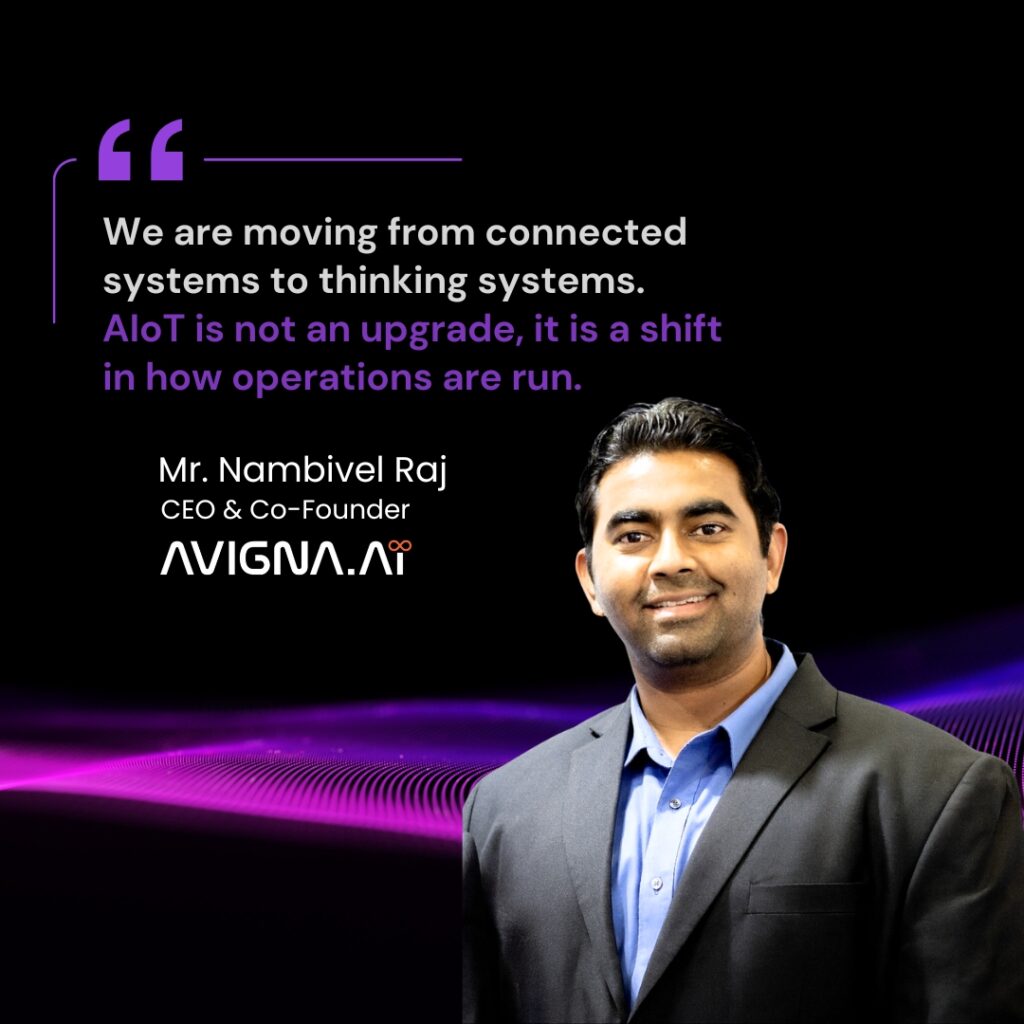
This makes distributed intelligence a more relevant architectural model for industrial AI.
The opportunity is not to replace cloud platforms with edge devices. It is to build a connected environment in which local processing, central intelligence and operational applications share data, context and control.
For manufacturers and OEMs, the quality of this architecture will influence how effectively AI can be introduced across connected equipment and distributed operations.
Explore how AvignaAIEdge and AvignaCube can support your industrial edge AI and IoT architecture. Contact Avigna.AI to discuss your requirements.