Why Edge AI Will Define the Next Generation of Enterprise Operations
For years, organizations focused on building connected environments through IoT platforms, cloud infrastructure, and centralized data systems. The assumption was straightforward: more connected systems would naturally create smarter operations.
That is not how most enterprises experienced it.
Many organizations today already operate with connected devices, data pipelines, and monitoring infrastructure in place. Yet operational responsiveness continues to be limited by latency, fragmented systems, and delayed decision cycles.
Edge AI is becoming central to the future of enterprise AIoT. The real challenge is no longer data collection. The challenge is acting on operational signals within the timeframe where decisions still matter.
At Avigna.AI, we see this shift happening across manufacturing, logistics, warehousing, utilities, and distributed industrial operations. Enterprises are increasingly moving beyond basic connectivity and investing in AI-powered IoT solutions that can support faster, localized, and more intelligent decision-making.
What Is Edge AI in AIoT?
Edge AI refers to the deployment of artificial intelligence models closer to where operational data is generated.
Instead of sending all sensor and operational data to centralized cloud systems for processing, Edge AI enables local processing and real-time inference directly at the edge.
In enterprise AIoT environments, this creates several advantages:
- Reduced latency
- Faster anomaly detection
- Lower bandwidth dependency
- Improved operational resilience
- Real-time operational responsiveness
This architectural shift is becoming increasingly important for enterprises managing high-volume operational environments.
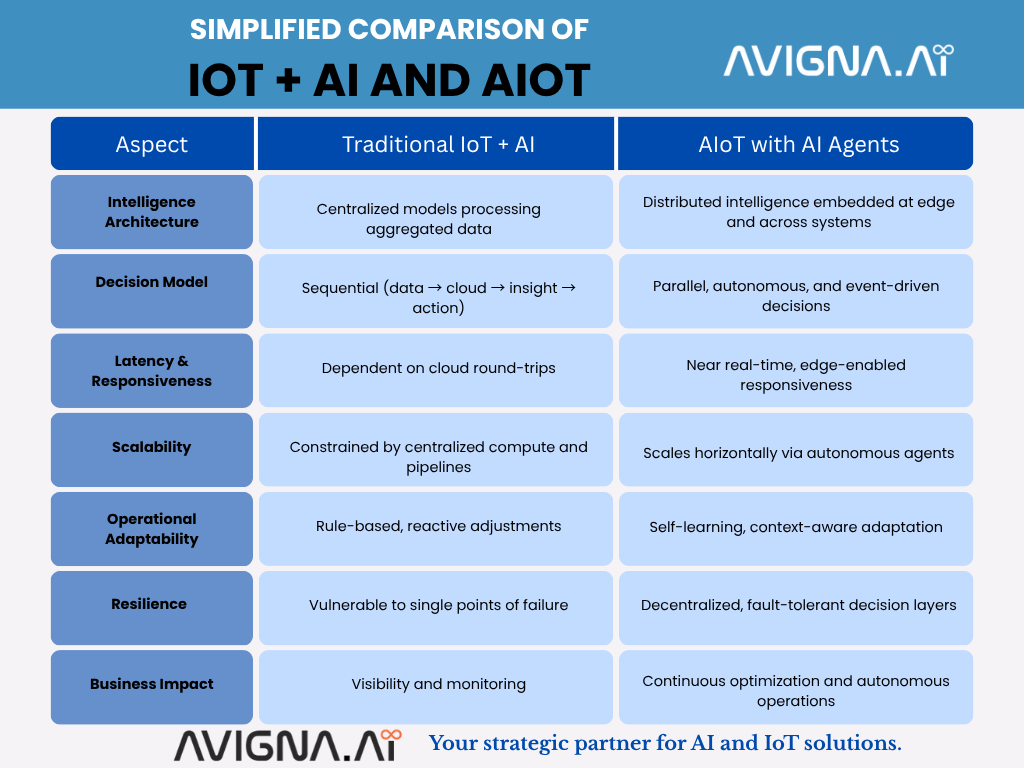
Why Centralized Architectures Are Reaching Operational Limits
Cloud infrastructure remains essential for enterprise analytics, orchestration, and historical modeling. However, relying entirely on centralized processing introduces challenges in operationally sensitive environments.
Manufacturing systems, warehouse automation environments, and distributed industrial assets continuously generate operational signals that require immediate interpretation. When every decision depends on centralized processing, latency becomes unavoidable.
This is where edge AI IoT solutions are creating measurable enterprise value. By enabling localized intelligence, organizations can reduce processing delays and improve decision execution directly within operational environments.
For CTOs, this is increasingly becoming an architectural requirement rather than an experimental capability.
Where Enterprises Are Seeing Measurable AIoT Impact
The most successful enterprise AIoT initiatives are focused on operational responsiveness.
One of the strongest examples is predictive maintenance for manufacturing.
Traditional maintenance models rely heavily on schedules and manual inspections. AIoT systems, however, continuously evaluate machine conditions using operational data such as vibration, pressure, temperature, and performance drift.
This allows organizations to reduce equipment downtime using AI by identifying failure patterns before disruption affects production.
The business impact is significant:
- Reduced unplanned downtime
- Improved production continuity
- Faster maintenance response
- Better asset utilization
- Lower operational risk
Similarly, enterprises are using IoT data analytics for operations to improve visibility across distributed environments.
Operational data is no longer treated as a static reporting layer. It is becoming a continuous decision-support system.
This shift is especially relevant in warehouse and logistics operations, where enterprises are working to improve warehouse efficiency with AI through real-time coordination of inventory movement, automation systems, and operational workflows.
Why AIoT Projects Often Struggle to Scale
One of the biggest misconceptions in enterprise AIoT is that successful pilots naturally translate into scalable systems.
In reality, many initiatives stall because the underlying architecture cannot support operational scale.
We frequently see enterprises facing:
- Fragmented data environments
- Legacy integration gaps
- Inconsistent operational data
- Centralized processing bottlenecks
- Limited interoperability across systems
This is why AI + IoT integration services are becoming increasingly important for enterprise AIoT implementation.
Without unified systems, even advanced AI models operate in isolation.
The enterprises generating long-term value from AIoT are the ones prioritizing scalable architecture, interoperability, and operational alignment from the beginning.
The Strategic Shift CTOs Should Be Thinking About
The AIoT discussion is evolving. The conversation is no longer about whether enterprises should adopt AI.
The real question is whether enterprise systems are structured to support intelligence at scale.
At Avigna.AI, we believe the future of AIoT will be defined by how effectively organizations distribute intelligence across operational environments.
Enterprises that can process operational signals faster, respond to variability earlier, and execute decisions closer to the point of activity will operate with greater resilience and operational control.
This is why Edge AI is becoming foundational to modern industrial AIoT solutions.
It enables organizations to move from reactive operations toward systems capable of continuous, real-time optimization.

Key Takeaways
- Edge AI reduces latency in enterprise AIoT environments
- AI-powered IoT solutions are increasingly focused on operational responsiveness
- Predictive maintenance for manufacturing remains one of the highest-value AIoT use cases
- Scalable AIoT depends on interoperability and reliable operational data
- Edge AI enables faster decision-making across distributed operations
- AI + IoT integration services are critical for enterprise-scale implementation
Final Perspective
Enterprise operations are entering a new phase. Connected infrastructure alone is no longer enough. Organizations now need systems capable of interpreting operational conditions, responding in real time, and supporting intelligence-driven execution at scale.
That transition is redefining enterprise architecture. At Avigna.AI, we see Edge AI as one of the most important enablers of that shift. Not because it changes how enterprises collect data. But because it changes how quickly and effectively they can act on it.
About Avigna.AI
Avigna.AI is an AIoT consulting and implementation company helping enterprises build scalable AI-powered IoT solutions, Edge AI systems, and advanced IoT architectures.
Our expertise includes predictive maintenance, industrial automation, IoT data analytics for operations, intelligent warehouse systems, and enterprise AIoT implementation services.
If your enterprise AIoT initiatives are limited by latency, fragmented systems, or delayed operational decisions, it may be time to evaluate whether your architecture is ready for Edge AI at scale.
Connect with Avigna.AI to discuss enterprise AIoT consulting, Edge AI strategy, and scalable implementation services.
FAQs
What is Edge AI in AIoT?
Edge AI in AIoT refers to processing AI models closer to connected devices and operational environments instead of relying entirely on centralized cloud infrastructure.
Why is Edge AI important for enterprises?
Edge AI reduces latency, improves operational responsiveness, and enables faster real-time decision-making across distributed operations.
How does AIoT help reduce downtime?
AIoT systems continuously monitor operational conditions and identify patterns associated with equipment failure, enabling predictive maintenance and early intervention.
What industries benefit most from Edge AI?
Manufacturing, logistics, warehousing, utilities, industrial automation, and distributed infrastructure environments are among the industries seeing the highest impact from Edge AI adoption.