The Rise of AIoT: A Shift Hidden in Plain Sight
There is a quiet paradox at the heart of modern infrastructure. We have built systems that can sense almost everything, yet act on very little. Across utilities, HVAC networks, and smart city infrastructure, the Internet of Things has reached a level of maturity where visibility is no longer the constraint. Data is abundant, continuous, and increasingly precise.
And yet, the moment between insight and action remains delayed. That delay is where inefficiency resides.
The Real Limitation of IoT Systems Today
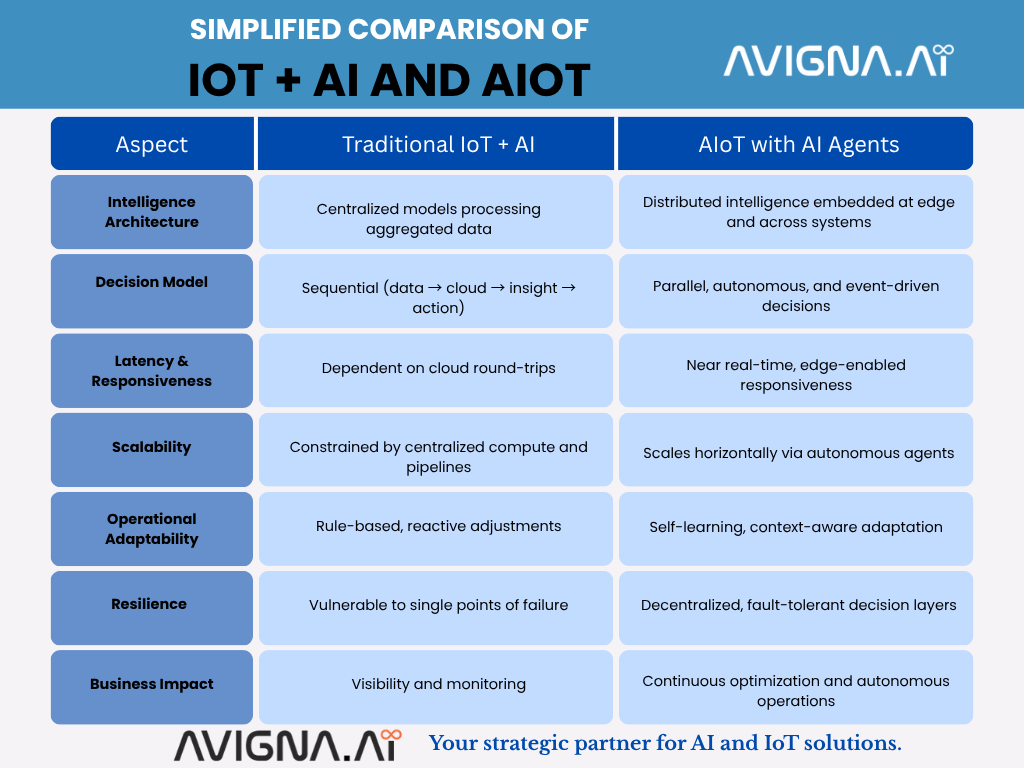
The prevailing architecture of IoT was designed for observation.
Devices capture signals. Platforms aggregate them. Dashboards present them. Decisions follow.
This model assumes that human intervention will bridge the gap between data and action.
At smaller scales, it works. At systemic scale, it introduces friction.
The limitation is not the lack of data. It is the lack of decision velocity.
In environments where conditions shift continuously, the ability to act in real time is not an enhancement. It is a requirement.
AI and IoT: Moving Beyond Visibility
The convergence of AI and IoT introduces a fundamentally different paradigm.
AIoT systems do not treat data as a record of what has happened. They treat it as a signal for what should happen next.
This distinction, while subtle, is operationally significant.
With AI solutions in IoT, systems begin to interpret context, evaluate multiple variables simultaneously, and initiate actions without waiting for external input. Decision-making moves closer to the source of data.
Not centralized. Not delayed. But continuous.
What AIoT Implementation Looks Like in Practice
The value of AIoT implementation becomes evident in operational environments where responsiveness directly impacts outcomes.
In utilities, connected systems have long monitored demand and supply fluctuations. AIoT enables dynamic balancing, adjusting distribution in real time based on evolving conditions.
In HVAC ecosystems, sensors provide granular environmental data. AI-driven systems interpret that data to continuously optimize performance, aligning energy efficiency with real-world usage patterns.
In smart infrastructure, systems that once reacted to disruptions can now anticipate them, reducing downtime and improving resilience.
In each case, the transition is the same.
From reporting conditions to actively shaping them.
From Connected Infrastructure to Intelligent Systems
What is emerging is a shift from connected systems to intelligent systems.
Connected systems provide visibility.
Intelligent systems provide direction.
Embedding intelligence into IoT environments requires rethinking how decisions are made, where they are made, and how quickly they can be executed.
It also requires moving beyond centralized control toward distributed intelligence, where systems are capable of responding autonomously within defined parameters.
Why Enterprises Are Accelerating AIoT Adoption
The acceleration of AIoT solutions is being driven by structural realities.
Data volumes are increasing beyond human processing capacity.
Operational environments are becoming more dynamic.
Competitive pressure is demanding faster and more precise execution.
Under these conditions, systems that merely report will struggle to keep pace.
Systems that can decide will define performance.
The Role of an IoT Partner in India
For many organizations, the transition to AIoT is not constrained by intent, but by execution.
Selecting the right IoT partner in India is critical to navigating this shift. The challenge is not limited to deploying connected devices or integrating platforms. It lies in designing systems where intelligence is embedded into operational workflows.
This includes aligning AI models with real-world constraints, ensuring real-time processing capabilities, and integrating decision layers directly with execution systems.
Without this alignment, AI remains theoretical and IoT remains observational.
Avigna.AI Helps You From Insight to Action
The evolution of IoT was defined by connectivity. The evolution of AIoT will be defined by autonomy.
Enterprises that recognize this distinction early will move beyond visibility toward continuous optimization and real-time responsiveness.
Those that do not may find themselves constrained by systems that inform, but do not act.
If you are evaluating AIoT implementation, or exploring how AI and IoT can work together across utilities, HVAC, or infrastructure environments, this is the moment to reassess your current systems.
We work with organizations to design and implement AIoT solutions that move beyond reporting toward intelligent, decision-driven operations.
If this aligns with your priorities, feel free to contact us at queries@avigna.ai or schedule time for a focused discussion.