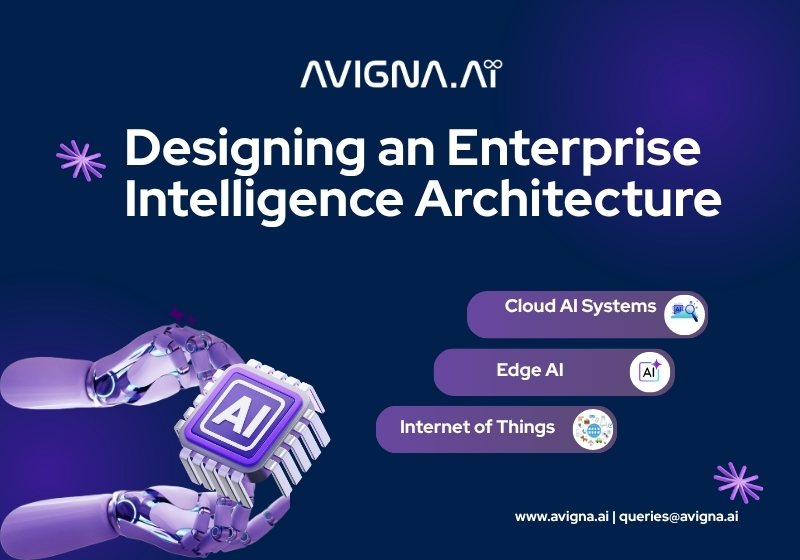
Designing an Enterprise Intelligence Architecture Across IoT, Edge AI, and Cloud AI Systems
Enterprise systems are entering a phase where connectivity alone is no longer a differentiator.
Most organizations today already operate with IoT deployments, cloud infrastructure, and analytics platforms. The gap is not adoption. The gap is architectural coherence, how these systems work together to support real-time operational decisioning.
At Avigna.AI, we are focused on building an integrated enterprise intelligence architecture that connects IoT systems, Edge AI, and cloud AI platforms such as Microsoft Azure AI Foundry, supported by industrial-grade IoT platforms like Avigna Cube.
The objective is not to add more systems. It is to reduce fragmentation across sensing, intelligence, and execution layers.
IoT Consulting: Defining the Data and Operational Foundation
IoT consulting is the starting point of enterprise intelligence architecture.
At this layer, the focus is not devices, but system design. This includes how operational data is generated, structured, transmitted, and integrated across enterprise environments.
A strong IoT foundation addresses:
- Device and sensor strategy across environments
- OT and IT system alignment
- Data ingestion and normalization frameworks
- Integration with enterprise applications
Without this layer, downstream AI and analytics systems operate on inconsistent or incomplete data, limiting reliability at scale.
IoT Implementation: Converting Architecture into Operational Systems
IoT implementation translates design into functioning enterprise systems.
This is where complexity typically emerges. Enterprises often have multiple vendors, legacy systems, and distributed operational environments that need to function as a unified structure.
Effective IoT implementation ensures:
- Reliable data flow from operational environments
- Integration with ERP, MES, and enterprise platforms
- Real-time monitoring across assets and facilities
- Standardized operational data pipelines
At this stage, IoT data analytics for operations becomes critical, as it determines whether captured data can be operationalized or remains purely observational.
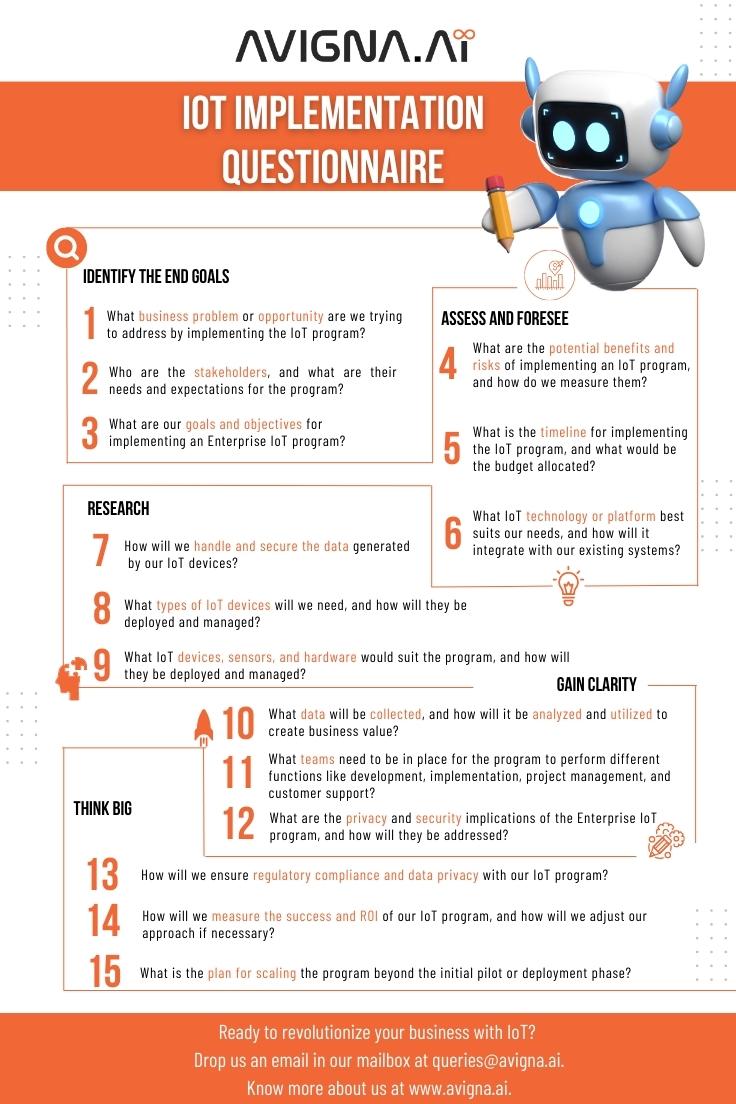
Edge AI: Enabling Real-Time Intelligence at the Operational Layer
Edge AI introduces a distributed intelligence layer closer to where data is generated.
In traditional architectures, data is sent to centralized systems for processing. This introduces latency, which becomes a constraint in time-sensitive environments.
Edge AI changes this by enabling:
- Localized AI inference near devices and systems
- Reduced dependency on centralized cloud processing
- Faster response to operational events
- Improved resilience in distributed environments
This is particularly relevant for industrial environments where milliseconds impact production stability.
In this architecture, edge AI IoT solutions are not optional. They are a requirement for operational responsiveness at scale.
AIoT: The Intelligence Layer Connecting Systems and Decisions
AIoT is not a standalone system. It is an architectural framework that connects IoT systems and AI models into a continuous decision loop.
In practice, AIoT enables operational intelligence to move beyond reporting into active decision support.
Key outcomes include:
- Predictive maintenance for manufacturing environments
- Early detection of operational anomalies
- Optimization of asset utilization
- Continuous operational intelligence across systems
This is where enterprises begin to systematically reduce equipment downtime using AI, shifting from reactive to predictive operational models.
Azure AI Foundry: Scaling AI Across the Enterprise
As AI systems mature, enterprises require structured environments for model development, deployment, and governance.
Microsoft Azure AI Foundry provides a cloud-native foundation for:
- AI model lifecycle management
- Scalable deployment across enterprise systems
- Integration with cloud data ecosystems
- Governance and monitoring of AI workloads
Within this architecture, cloud AI is not isolated. It becomes the intelligence backbone that supports learning, optimization, and long-term model evolution.
When combined with Edge AI, it enables a hybrid intelligence model: real-time execution at the edge and deep learning at the cloud layer.
Avigna Cube: The Operational Integration Layer
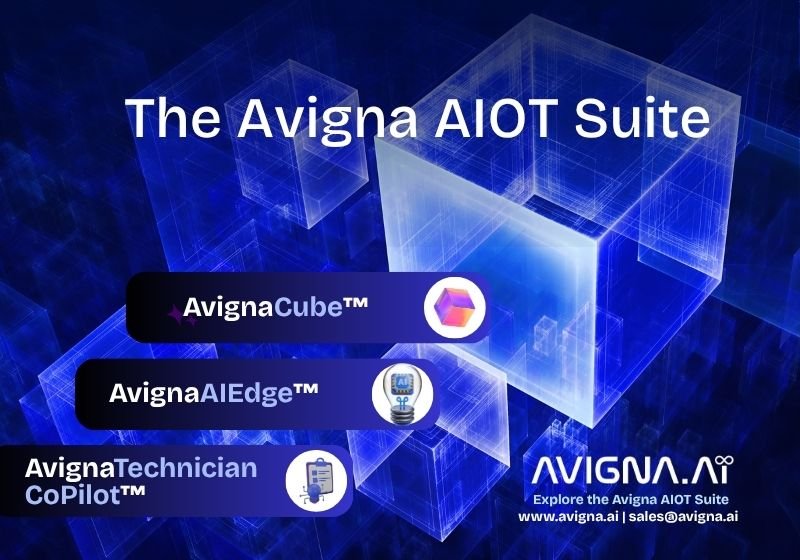
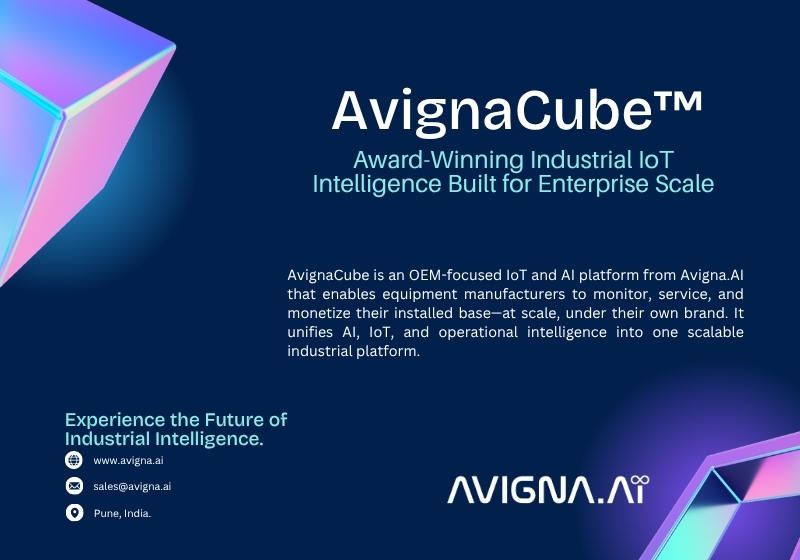
At Avigna.AI, we have developed Avigna Cube, our award-winning IoT platform designed to unify operational environments across devices, systems, and enterprise applications.
Avigna Cube functions as the operational integration layer that connects:
- IoT data ingestion systems
- Edge AI processing environments
- Cloud AI platforms
- Enterprise applications and workflows
Its focus is not on replacing existing systems, but on reducing fragmentation and enabling coordinated execution across them.
This is where IoT, AIoT, and Edge AI move from isolated capabilities to an integrated operational system.
The Enterprise Shift: From Connected Systems to Intelligent Architecture
The direction of enterprise architecture is becoming clearer.
IoT provides visibility.
Edge AI provides responsiveness.
Cloud AI provides intelligence at scale.
AIoT connects them into a unified decision framework.
However, value is only realized when these layers are intentionally designed to work together, not deployed as independent initiatives.
This is where many enterprise AIoT programs fail, not due to technology gaps, but due to architectural fragmentation.
Key Takeaways
- IoT defines the operational data foundation
- Edge AI enables real-time decision-making at the source
- AIoT connects intelligence across systems and workflows
- Azure AI Foundry supports scalable cloud AI lifecycle management
- Avigna Cube provides the operational integration layer across environments
- Enterprise value depends on architectural coherence, not isolated technology adoption

Summing Up
Enterprises are moving beyond experimentation into structured intelligence architectures.
The focus is no longer on whether IoT, AI, or Edge computing should be adopted. The focus is on how these systems are designed to operate together at scale.
At Avigna.AI, we are building this integrated architecture across IoT consulting, IoT implementation, Edge AI, AIoT systems, and cloud AI platforms, supported by Avigna Cube.
The goal is not more technology. It is a more coherent enterprise operating system.
If your enterprise is working with fragmented IoT systems, isolated AI initiatives, or cloud-first architectures that struggle with real-time responsiveness, it may be time to evaluate your enterprise intelligence architecture.
Connect with Avigna.AI to discuss how IoT, Edge AI, and cloud AI systems can be structured into a unified operational framework.