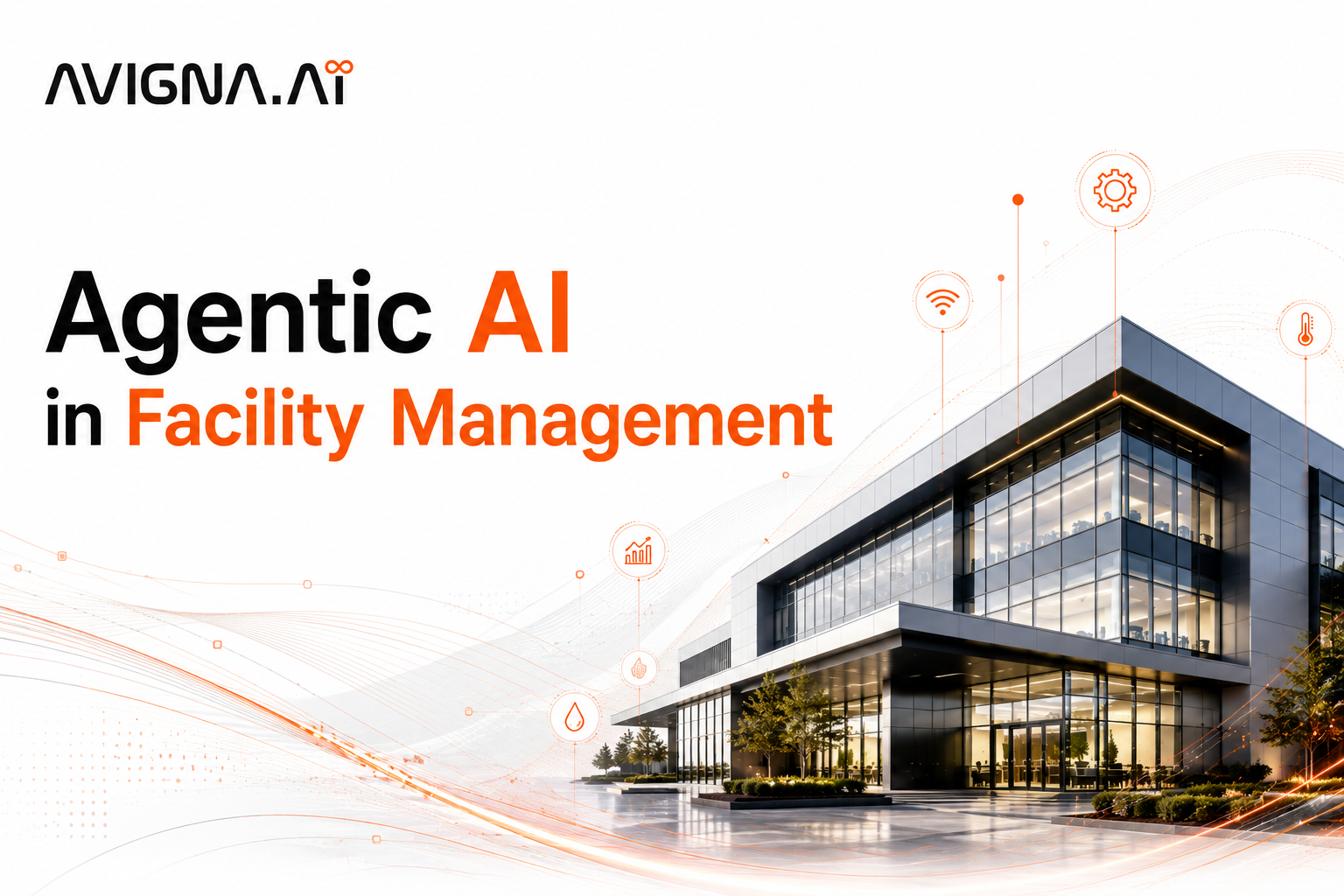
Agentic AI for Facility Management: Benefits, Use Cases, and Business Impact
Did you know? According to the International Energy Agency (IEA), building operations account for approximately 30% of global final energy consumption and 26% of global energy-related emissions, making them one of the largest contributors to worldwide energy use and carbon emissions. Yet, a significant portion of this energy is wasted due to inefficient operations, reactive maintenance, and disconnected building systems.
As organizations strive to reduce costs, improve sustainability, and deliver better occupant experiences, traditional facility management approaches are no longer enough. Modern facilities generate enormous volumes of operational data through IoT sensors, Building Management Systems (BMS), and connected assets. The challenge is no longer collecting data. It is turning that data into intelligent, real-time decisions.
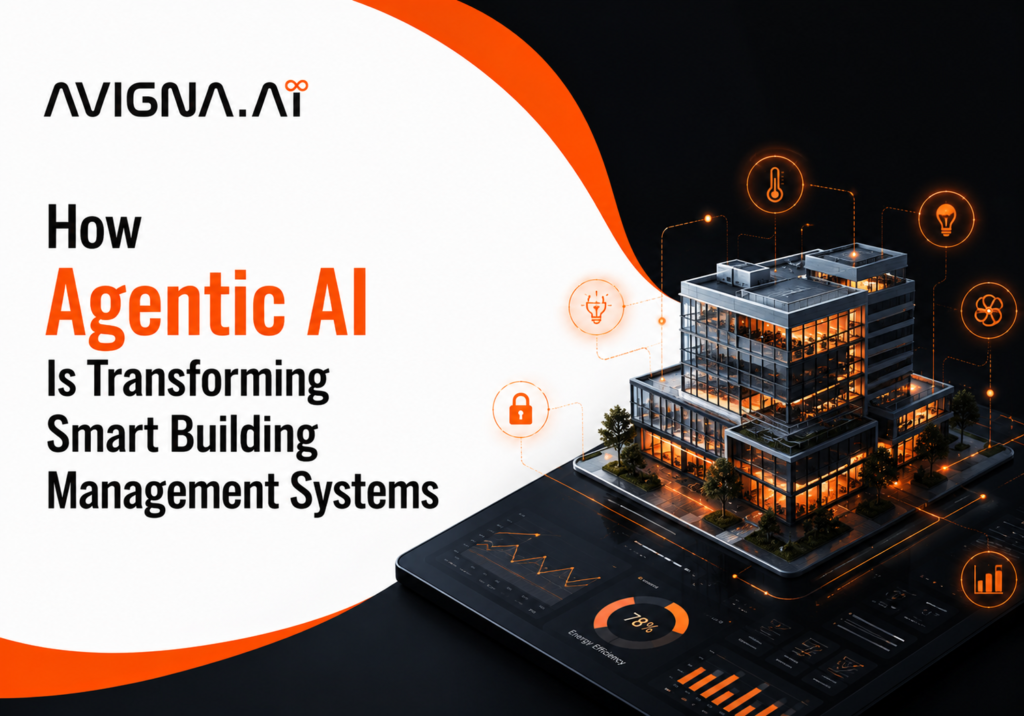
This is where Agentic AI Facility Management is redefining the future of facility operations.
Unlike conventional automation that follows predefined rules, Agentic AI can perceive its environment, analyze contextual data, make informed decisions, and initiate actions autonomously. Combined with IoT and cloud-native platforms, it enables organizations to move from reactive maintenance to Intelligent Facility Management that continuously optimizes building performance.
Whether managing commercial buildings, manufacturing plants, hospitals, warehouses, or data centers, AI-powered Facility Management helps organizations improve operational efficiency, reduce downtime, optimize energy consumption, and make smarter decisions at scale.
Agentic AI Facility Management at a Glance
| Aspect | Overview |
| Definition | Agentic AI uses autonomous AI agents to monitor, analyze, and optimize facility operations in real time. |
| Primary Benefits | Predictive maintenance, energy optimization, automated workflows, improved occupant comfort, and lower operating costs. |
| Core Technologies | IoT sensors, Artificial Intelligence, Machine Learning, Building Management Systems (BMS), Intelligent Facility Management Systems (IFMS), CAFM, and IWMS. |
| Best Suited For | Commercial buildings, manufacturing, healthcare, retail, logistics, smart campuses, and data centers. |
| Business Value | Higher asset reliability, reduced maintenance costs, improved sustainability, and data-driven decision-making. |
What is Agentic AI in Facility Management?
Agentic AI Facility Management refers to the use of autonomous AI agents that continuously monitor facility data, interpret changing conditions, make operational decisions, and execute actions with minimal human intervention.
Unlike traditional AI, which primarily provides recommendations or insights, Agentic AI can proactively coordinate multiple systems across a facility. It acts as an intelligent operational layer that connects data from Building Management Systems (BMS), Computer-Aided Facility Management (CAFM) platforms, Integrated Workplace Management Systems (IWMS), IoT devices, and enterprise applications.
For example, if occupancy sensors indicate that a conference floor is unused, the AI agent can automatically adjust HVAC settings, reduce lighting levels, and update energy consumption forecasts without waiting for manual instructions. Similarly, when equipment sensors detect abnormal vibration patterns, the system can initiate a predictive maintenance workflow before the equipment fails.
This ability to observe, reason, and act makes Agentic AI a foundational technology for Smart Facility Management and next-generation Intelligent Facility Management Systems (IFMS).
How Agentic AI Works in Intelligent Facility Management
Agentic AI combines data, analytics, and automation into a continuous decision-making cycle.
1. Data Collection
IoT sensors installed across the facility continuously collect information such as:
- Temperature and humidity
- Equipment performance
- Energy consumption
- Air quality
- Occupancy levels
- Security events
- Water usage
These data streams provide a real-time view of facility operations.
2. Intelligent Analysis
AI models analyze operational data alongside historical maintenance records, weather conditions, occupancy trends, and equipment behavior to identify anomalies and predict future events.
Instead of simply reacting to alarms, the system understands patterns and evaluates the potential business impact of every event.
3. Autonomous Decision Making
Once an issue is identified, AI agents determine the most effective response.
Depending on predefined governance policies, they can:
- Adjust HVAC settings
- Optimize lighting schedules
- Prioritize maintenance requests
- Allocate technicians
- Trigger emergency notifications
- Generate work orders automatically
Human teams remain in control, but AI significantly reduces manual intervention for routine operational decisions.
4. Continuous Learning
Every action generates new operational data.
Agentic AI continuously learns from outcomes, improving prediction accuracy and operational efficiency over time. This adaptive learning capability enables facilities to become increasingly intelligent as more data becomes available.
Key Benefits of Agentic AI Facility Management
Predictive Maintenance
Reactive maintenance often leads to unexpected equipment failures, production disruptions, and higher repair costs.
Agentic AI continuously monitors asset health using sensor data and machine learning models to detect early warning signs. Maintenance activities are scheduled based on actual equipment condition rather than fixed timelines.
This approach:
- Reduces unplanned downtime
- Extends equipment lifespan
- Improves maintenance efficiency
- Lowers operational costs
Energy Optimization
Energy is one of the largest operating expenses for commercial facilities.
Agentic AI dynamically adjusts HVAC systems, lighting, ventilation, and other energy-intensive assets based on occupancy, weather conditions, and real-time demand.
Rather than relying on static schedules, facilities continuously optimize energy usage without compromising occupant comfort.
Faster Incident Response
When an operational issue occurs, every minute matters.
Instead of waiting for manual detection and escalation, AI agents identify anomalies immediately, determine root causes using multiple data sources, and initiate corrective actions.
This significantly reduces response times while improving overall service reliability.
Improved Occupant Experience
Modern workplaces are increasingly expected to provide comfortable, safe, and productive environments.
By continuously monitoring indoor environmental conditions such as temperature, air quality, lighting, and occupancy, AI-powered Facility Management helps create healthier and more comfortable spaces for employees, customers, patients, and visitors.
Traditional Facility Management vs. Agentic AI Facility Management
As facilities become more connected, the limitations of traditional facility management become increasingly evident. Manual processes, isolated systems, and reactive maintenance make it difficult to achieve operational efficiency at scale.
Agentic AI introduces a more intelligent, autonomous approach by continuously analyzing data, coordinating systems, and taking proactive actions.
| Traditional Facility Management | Agentic AI Facility Management |
| Reactive maintenance schedules | Predictive and condition-based maintenance |
| Manual monitoring of building systems | Continuous AI-driven monitoring and optimization |
| Siloed systems with limited data sharing | Integrated decision-making across BMS, CAFM, IWMS, and IoT platforms |
| Static energy management | Real-time energy optimization based on occupancy and demand |
| Manual work order creation | Automated workflow orchestration and task assignment |
| Limited operational insights | Predictive analytics and actionable intelligence |
This shift enables organizations to transition from managing facilities to continuously optimizing them.
Real-World Use Cases of Agentic AI for Smart Facilities
Commercial Buildings
Commercial office spaces are expected to deliver comfort, efficiency, and sustainability while controlling operational costs.
Agentic AI helps facility managers:
- Optimize HVAC and lighting based on occupancy.
- Monitor indoor air quality and environmental conditions.
- Reduce energy consumption during non-operational hours.
- Predict equipment failures before they impact occupants.
The result is a smarter workplace that enhances employee experience while lowering operational expenses.
Manufacturing Facilities
Manufacturing environments rely on continuous equipment availability.
By combining IoT sensors with AI-powered Facility Management, manufacturers can:
- Predict machine failures before production is affected.
- Optimize utility consumption across production lines.
- Monitor environmental conditions in critical areas.
- Reduce maintenance costs and improve asset utilization.
This enables more resilient and efficient facility operations.
Healthcare Facilities
Hospitals operate around the clock and cannot afford disruptions to critical infrastructure.
Agentic AI supports healthcare facilities by:
- Monitoring HVAC systems in operating theatres and clean rooms.
- Ensuring uninterrupted power and environmental control.
- Automating compliance monitoring.
- Prioritizing maintenance for critical assets.
This improves patient safety while reducing operational risk.
Warehouses and Logistics Centers
Warehouses depend on reliable infrastructure to maintain operational efficiency.
Agentic AI enables:
- Intelligent lighting control.
- Climate monitoring for sensitive inventory.
- Equipment health monitoring.
- Automated maintenance scheduling.
- Energy optimization across large facilities.
These capabilities improve productivity while reducing facility operating costs.
Data Centers
Data centers require continuous availability and precise environmental management.
Agentic AI helps operators:
- Optimize cooling systems.
- Monitor power utilization.
- Detect anomalies before equipment failure.
- Improve energy efficiency through AI Building Automation.
For organizations operating mission-critical infrastructure, this translates into improved uptime and reduced operational expenditure.
Integrating Agentic AI with Existing Facility Management Systems
One of the biggest advantages of Agentic AI is that it complements existing technology investments rather than replacing them.
It integrates seamlessly with platforms such as:
- Building Management Systems (BMS) for monitoring HVAC, lighting, security, and utilities.
- Computer-Aided Facility Management (CAFM) software for maintenance planning and asset management.
- Integrated Workplace Management Systems (IWMS) for workplace, space, and lease management.
- IoT platforms that collect real-time operational data from connected assets.
By acting as an intelligent orchestration layer, Agentic AI brings together information from these systems, identifies patterns, and recommends or executes actions automatically. This unified approach provides greater visibility across facility operations and enables faster, more informed decision-making.
Challenges to Consider Before Implementation
While the benefits are significant, successful implementation requires a strategic approach.
Organizations should focus on:
- Data Quality: AI models depend on accurate, reliable, and consistent operational data.
- System Integration: Legacy systems should be integrated to enable a unified view of facility operations.
- Cybersecurity: Connected facilities require strong security measures to protect operational technology and sensitive data.
- Change Management: Facility teams should be trained to work alongside AI-driven systems and automated workflows.
A phased implementation strategy helps organizations realize value quickly while minimizing operational disruption.
The Future of Intelligent Facility Management
The future of facility management lies in autonomous, data-driven operations.
As IoT adoption continues to grow and buildings become increasingly connected, Agentic AI will play a central role in enabling facilities to predict issues, optimize resources, and make operational decisions in real time.
Emerging technologies such as Digital Twins, Edge AI, and advanced predictive analytics will further enhance intelligent facility management by creating virtual representations of physical assets, enabling real-time simulation and continuous optimization.
Rather than simply responding to problems, future facilities will anticipate them, adapt automatically, and improve continuously.
Organizations that invest in Agentic AI today will be better positioned to reduce operating costs, improve sustainability, strengthen business resilience, and deliver superior occupant experiences.
Conclusion
Facility management is evolving from reactive maintenance to intelligent, autonomous operations. As organizations manage increasingly complex facilities, traditional approaches struggle to keep pace with growing operational demands.
Agentic AI Facility Management empowers organizations to move beyond monitoring and automation by enabling systems to analyze, decide, and act in real time. Whether optimizing energy consumption, improving predictive maintenance, enhancing occupant comfort, or streamlining facility operations, Agentic AI delivers measurable business value across industries.
For enterprises looking to build smarter, more sustainable facilities, adopting AI-powered Facility Management is no longer a future initiative. It is a strategic investment in operational excellence.
Transform Intelligent Facility Management with Avigna.AI
At Avigna.AI, we help enterprises harness the power of Agentic AI, IoT, and intelligent automation to build connected, data-driven facilities.
Our AI-powered solutions enable organizations to optimize building performance, improve asset reliability, reduce operational costs, and make faster, more informed decisions across commercial buildings, manufacturing plants, warehouses, healthcare facilities, and data centers.
Ready to modernize your facility operations? Connect with the experts at Avigna.AI to discover how Agentic AI can transform your facilities into intelligent, autonomous ecosystems.