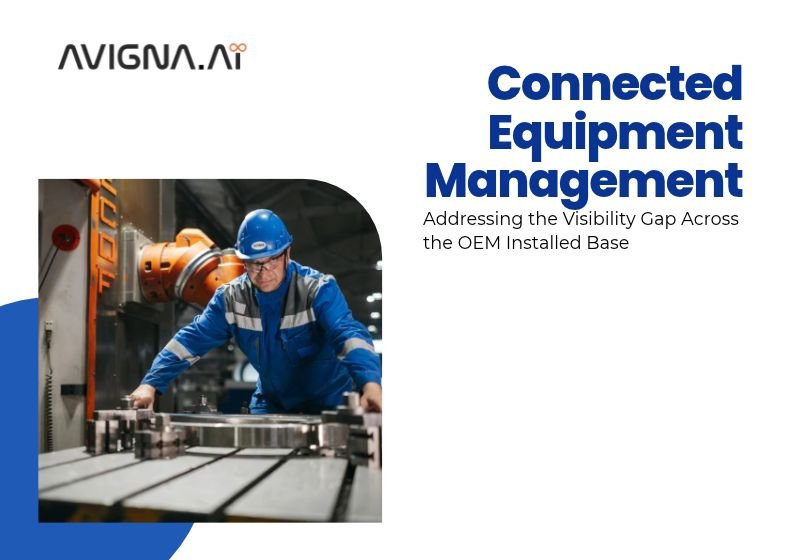
Connected Equipment Management: Addressing the Visibility Gap Across the OEM Installed Base
For equipment manufacturers, the commercial relationship does not end when a machine leaves the factory. Its operational life begins at the customer’s premises, often across multiple locations, operating environments and service conditions.
Yet, maintaining visibility into equipment performance after deployment remains a challenge for many original equipment manufacturers (OEMs).
Machine telemetry may be available through connected devices. Maintenance records may sit within service management systems. Customer interactions may be documented in separate portals, while technical manuals and equipment specifications remain in document repositories.
Individually, these systems contain useful information. Collectively, they do not always provide a unified understanding of how equipment performs throughout its lifecycle.
This creates a connected equipment management challenge: OEMs can manufacture and deploy sophisticated machinery, but may lack the integrated digital infrastructure required to monitor, understand, service and continuously improve their installed base.
Connected equipment management is the process of collecting, integrating, monitoring and analysing data from deployed equipment to understand asset performance, operational conditions, maintenance requirements and service activity throughout the equipment lifecycle.
Industrial IoT platforms are helping OEMs address this challenge by connecting equipment data with analytics, operational workflows and AI-driven intelligence.
However, establishing connectivity is only the first step. The larger challenge lies in making equipment data accessible, contextual and actionable. Here are siz connected equipment challenges OEMs face.
1. Fragmented Equipment Data Across Product Lines and Customer Locations
OEMs frequently manage different equipment categories, product generations, communication protocols and customer environments.
As product portfolios expand, the technology used to monitor and manage these assets may become equally fragmented.
One product line might use a dedicated monitoring application, while another relies on a separate gateway or third-party IoT platform. Regional service teams may also maintain independent systems for tracking equipment performance and maintenance activity.
The result is a fragmented operational view.
Without a unified data infrastructure, OEMs may struggle to:
- Monitor equipment performance across multiple product lines.
- Consolidate telemetry from different device types and protocols.
- Correlate machine performance with historical maintenance records.
- Compare equipment behaviour across customer locations.
- Establish a consistent view of asset health and service performance.
What OEMs need: A unified Industrial IoT platform that can ingest structured, unstructured and multimodal data, integrate with existing enterprise systems and provide a common operational view.
AvignaCube addresses this requirement through unified data ingestion, device management, stream processing and a knowledge graph connecting assets, components, sites, faults and procedures.
2. Limited Visibility Into Equipment Performance After Deployment
Once equipment is installed at customer premises, OEMs may have limited access to information about its actual operating conditions.
How frequently is the equipment being used? Are operating parameters within expected ranges? Are certain components experiencing recurring abnormalities? Does a particular installation environment influence equipment performance?
These questions become difficult to answer when connected equipment data is unavailable, incomplete or disconnected from asset context.
Limited visibility affects more than monitoring. It can also restrict product engineering teams from identifying recurring performance patterns and service teams from understanding the circumstances surrounding equipment faults.
For OEMs managing distributed equipment fleets, the challenge is to establish consistent visibility across deployed assets without depending entirely on manual reporting or individual customer interactions.
What OEMs need: Remote equipment monitoring supported by continuous data collection, asset health analytics, historical performance tracking and centralised visibility.
AvignaCube provides an AI-native data platform for monitoring equipment performance, contextualising asset information and enabling authorised users to query operational data through natural-language interfaces.
3. Reactive Maintenance and the Difficulty of Diagnosing Equipment Faults
Traditional equipment monitoring systems often rely on predefined thresholds and alarm conditions.
When a parameter crosses a specified limit, the system generates an alert. However, identifying the underlying reason for the deviation requires additional investigation.
A vibration anomaly, for example, may require examination of equipment operating conditions, component history, previous maintenance records and related fault patterns.
An alert identifies a deviation. It does not necessarily explain its cause.
For OEM service organisations, this distinction is important. Without contextual information, maintenance teams may spend considerable time reviewing historical records, consulting experienced engineers and coordinating troubleshooting activities.
The operational consequences can include:
- Longer diagnostic cycles.
- Repeated service interventions.
- Delayed fault resolution.
- Higher maintenance and service costs.
- Inconsistent troubleshooting across service teams.
What OEMs need: Predictive and diagnostic intelligence that combines equipment telemetry, historical incidents, asset relationships and relevant technical documentation.
AvignaCube combines machine learning capabilities for forecasting, anomaly detection and fault detection with generative AI and retrieval-based intelligence to explain anomalies and recommend next-best actions.
4. High Dependence on Manual Service Processes and Institutional Knowledge
Industrial equipment maintenance involves more than identifying a faulty component.
Technicians need access to equipment specifications, installation details, service manuals, maintenance procedures, spare parts information and previous service records.
Much of this knowledge is distributed across PDFs, internal portals, service applications and the experience of senior technicians.
When a technician encounters an unfamiliar fault, finding the relevant information can become a time-consuming process.
The problem becomes more pronounced when experienced personnel leave the organisation or when OEMs expand their service operations across multiple geographies.
Without a structured knowledge management system, equipment-specific expertise can remain difficult to access and reuse.
What OEMs need: An intelligent knowledge infrastructure that connects technical documentation, equipment history, troubleshooting procedures and service records.
AvignaCube provides a knowledge graph and retrieval-augmented generation (RAG) capabilities. These form the foundation for AvignaTechnicianCoPilot, which assists technicians with conversational troubleshooting, manual lookup, parts information and guided repair workflows.
5. Difficulty Managing Equipment Across Low-Connectivity and Remote Environments
Not every industrial asset operates in an environment with reliable internet connectivity.
Manufacturing facilities, remote installations, infrastructure sites and geographically distributed equipment fleets may experience intermittent network availability.
A cloud-dependent monitoring architecture can introduce operational limitations when equipment data must travel to a central platform before it can be processed.
Continuous transmission of high-volume data, including video, vibration and acoustic streams, can also increase bandwidth requirements.
For applications requiring local processing, waiting for cloud communication may not be appropriate.
What OEMs need: Edge computing infrastructure that supports local data collection, processing, anomaly detection and resilient synchronisation with central platforms.
AvignaAIEdge extends AvignaCube’s intelligence to the equipment level.
Its Core tier supports industrial protocol connectivity, data collection, rules-based processing and lightweight machine learning. Its GPU-accelerated AI+ tier extends these capabilities to local language models, computer vision and generative AI workloads.
The platform also supports store-and-forward processing, allowing data to be buffered during connectivity interruptions and synchronised when connectivity returns.
6. Difficulty Converting Connected Equipment Into Digital Revenue Opportunities
Connected equipment generates information that can support more than maintenance and operational monitoring.
Equipment usage patterns, asset health, performance trends and service history can help OEMs develop differentiated digital offerings.
These may include remote monitoring services, equipment analytics, digital maintenance support and outcome-oriented service arrangements.
However, developing these offerings requires more than connecting sensors to a cloud platform.
OEMs need an infrastructure that supports customer-specific access, secure data separation, branded applications, scalable integrations and configurable service offerings.
Without these capabilities, connected equipment initiatives can remain isolated technology projects rather than becoming part of a broader digital business strategy.
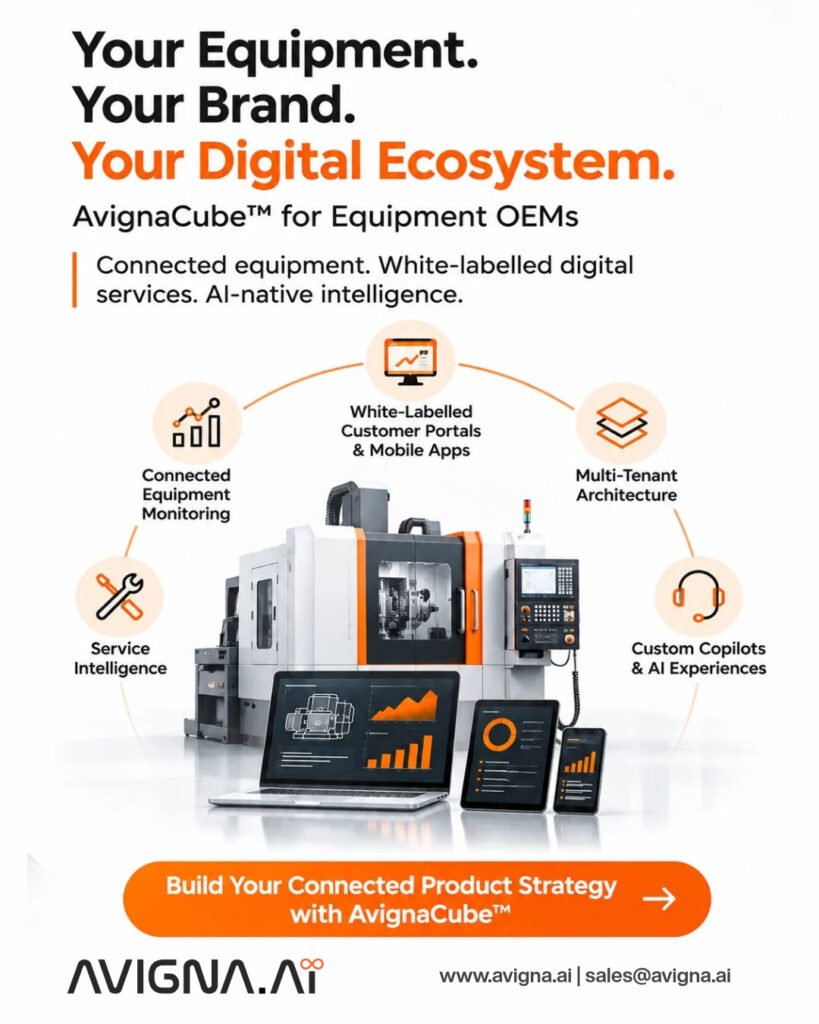
What OEMs need: An OEM-focused IoT platform that supports white-label experiences, multi-tenancy, extensibility and the development of digital services around connected products.
AvignaCube is designed with OEM enablement as a core architectural consideration. Its capabilities include white-label web and mobile portals, tenant isolation, configurable digital service offerings, APIs and SDKs.
This enables equipment manufacturers to develop connected experiences under their own brand while retaining control over their customer-facing digital services.
From Equipment Connectivity to Connected Equipment Intelligence
Addressing these challenges requires a coordinated architecture across connected devices, cloud infrastructure, AI capabilities and service operations.
An Industrial IoT platform should not be evaluated solely on its ability to collect machine data or display equipment performance dashboards.
OEMs should also examine whether the platform can:
- Integrate equipment across different product lines and communication protocols.
- Unify telemetry, documents, images and service information.
- Establish relationships between assets, components, faults and maintenance procedures.
- Support predictive analytics and contextual fault diagnosis.
- Extend intelligence to edge devices and low-connectivity environments.
- Enable technicians and service teams to act on equipment intelligence.
- Support branded digital services across multiple customers and geographies.
This is where AIoT architecture becomes particularly relevant.
Unlike a conventional IoT monitoring approach, an AI-native AIoT platform integrates data engineering, machine learning, generative AI, knowledge graphs and agentic orchestration into the platform architecture.
The objective is to move from collecting equipment information to interpreting operational conditions and supporting informed decisions.
How the Avigna AIoT Suite Addresses OEM Requirements
Avigna’s AIoT Platform Suite brings together three complementary products designed to connect equipment, cloud intelligence and field operations.
AvignaCube™: The AI-Native Industrial IoT Data Platform
AvignaCube provides the central data and intelligence infrastructure. It integrates equipment telemetry, operational records, technical documentation and other data sources into a unified platform. Its capabilities include device management, real-time data processing, predictive analytics, knowledge graphs, RAG and multi-agent orchestration. Built on Microsoft Azure, AvignaCube is designed for OEMs seeking to develop, scale and operationalise connected equipment solutions under their own brand.
AvignaAIEdge™: Industrial Edge Computing and AI
AvignaAIEdge brings data collection and AI processing closer to connected equipment. Available in Core and GPU-accelerated AI+ tiers, it supports industrial protocol connectivity, local processing, machine learning and, on the GPU tier, local language models and computer vision. It works with AvignaCube to synchronise equipment intelligence and support centralised fleet management.
AvignaTechnicianCoPilot™: AI Assistance for Maintenance and Field Service
AvignaTechnicianCoPilot extends equipment intelligence to field and plant technicians. It supports conversational troubleshooting, technical manual lookup, parts information, photo-based diagnostics, guided repair and digital service logging. Its responses draw on AvignaCube’s equipment knowledge graph, telemetry and retrieval infrastructure. Together, these products establish a connected intelligence architecture across equipment, cloud and field operations.
Frequently Asked Questions
What is connected equipment management?
Connected equipment management involves monitoring, collecting and analysing data from deployed machines and industrial assets. It helps OEMs understand equipment performance, asset health, operating conditions and maintenance requirements throughout the equipment lifecycle.
Why do OEMs need an Industrial IoT platform?
OEMs need Industrial IoT platforms to connect distributed equipment, consolidate operational data, monitor asset performance, support predictive maintenance and develop digital services around connected products.
How does AI improve connected equipment management?
AI can help OEMs identify equipment anomalies, analyse historical performance, explain potential fault causes, forecast maintenance requirements and provide contextual recommendations to service teams.
What is the role of edge AI in manufacturing?
Edge AI enables machine learning, computer vision and other AI workloads to run closer to industrial equipment. It is useful where latency, bandwidth, connectivity resilience or data-locality requirements make local processing important.
How can OEMs monetise connected equipment?
OEMs can explore digital services such as remote monitoring, equipment analytics, predictive maintenance support and digitally enabled service offerings. An OEM-focused IoT platform can provide the infrastructure required to deliver these services under the manufacturer’s own brand.
What should OEMs evaluate when selecting an IoT platform?
OEMs should evaluate device connectivity, protocol support, data integration, scalability, security, asset intelligence, edge computing, AI capabilities, multi-tenancy, white-labelling and enterprise integration requirements.
Building the Next Generation of Connected Equipment
Connected equipment management is becoming an important consideration for OEMs looking to strengthen product differentiation, improve service operations and develop digital capabilities around their installed base. The opportunity extends beyond remote monitoring. It involves creating an infrastructure that connects equipment data with contextual intelligence, AI-driven diagnostics and actionable service workflows. Avigna’s AIoT Suite brings these capabilities together through AvignaCube, AvignaAIEdge and AvignaTechnicianCoPilot.
Looking to build an intelligent connected equipment ecosystem? Explore the Avigna AIoT Suite and discover how your organisation can connect equipment, operational data and service intelligence through one integrated platform. Talk to Avigna about your AIoT requirements.