Edge AI for Energy and Utilities: Why Intelligence Needs to Work Closer to the Equipment
Energy infrastructure operates across environments with different connectivity conditions, response requirements and operational demands. While cloud platforms provide a central environment for managing equipment data and AI applications, not every task can depend entirely on a continuous connection to the cloud.
Remote substations, distributed energy assets and microgrids illustrate this challenge. Equipment must continue generating information, detecting relevant conditions and supporting local decisions even when connectivity is limited.
This is where edge AI becomes important. By bringing data processing and AI closer to the equipment, energy providers and utilities can reduce dependence on cloud connectivity for selected operational tasks while maintaining a connection to wider intelligence platforms.
Why Edge Computing Matters in Energy Operations
Traditional cloud-centric architectures send equipment data to a central platform for processing and analysis. This works well for many applications, including fleet-wide analytics, historical reporting and centralised asset management.
However, sending every data point to the cloud is not always practical.
Connectivity constraints: Remote sites may experience intermittent network access. Systems that depend entirely on continuous cloud communication can face limitations when connectivity is disrupted.
Response requirements: Certain monitoring and control tasks require local processing. Waiting for information to travel to a remote platform and back may not suit every operational requirement.
Bandwidth and data costs: Continuous transmission of high-volume data, particularly video, vibration and acoustic information, can increase network demands.
Operational continuity: Infrastructure operators may need local monitoring and decision logic to remain available during connectivity interruptions.
Edge computing addresses these challenges by processing selected data near its source. When combined with AI, it can support more sophisticated local analysis rather than relying exclusively on centralised processing.
What Is Edge AI for Energy and Utilities?
Edge AI combines local computing with machine learning and, where suitable hardware is available, other AI models. Instead of sending every input to a cloud platform, the system can analyse selected information at the equipment site.
For energy and utility applications, this can support several use cases.
1. Local equipment monitoring
Edge systems can collect data from sensors, controllers and connected equipment, apply rules and process selected signals locally. This helps support equipment monitoring at sites where continuous cloud communication may not be available.
2. Local anomaly detection
Machine learning models can analyse equipment signals, including vibration and acoustic patterns, to identify potential anomalies. Processing these signals locally can support timely alerts while reducing the need to transmit every raw data stream.
3. Microgrid and energy management
The Avigna product blueprint identifies energy microgrid control, including local decision-making for load balancing and demand response, as an edge use case. The appropriate architecture depends on the application, the control requirements and the safeguards required for the infrastructure involved.
4. Operation during connectivity interruptions
Edge systems can buffer data locally and synchronise it when connectivity returns. Local rules and supported processing can continue to operate without requiring every task to make a cloud round trip.
These capabilities do not mean every AI workload should run at the edge. Cloud platforms remain valuable for fleet-wide analysis, centralised management and workloads requiring greater computing resources. The objective is to determine which tasks benefit from local processing and which are better handled centrally.
Why Energy Infrastructure Needs an Edge-to-Cloud Architecture
Edge computing becomes more useful when local processing is connected to a wider operational platform.
A standalone edge device may collect data and generate local insights, but operators also need a way to manage devices, distribute software and models, and combine information from multiple sites.
An edge-to-cloud architecture divides responsibilities according to operational requirements.
The edge layer handles local data collection, supported analytics, rules and processing. The cloud layer provides a broader environment for aggregating information, analysing patterns across assets and managing the connected fleet.
This approach also supports a practical distinction between raw data and operationally relevant information. Rather than continuously transmitting every input, an edge system can send selected events, exceptions and insights to the cloud, depending on the configured application.
Security, device identity, encrypted communication, controlled updates and appropriate local safeguards remain essential. For critical energy infrastructure, edge AI must complement established operational technology controls rather than bypass them.
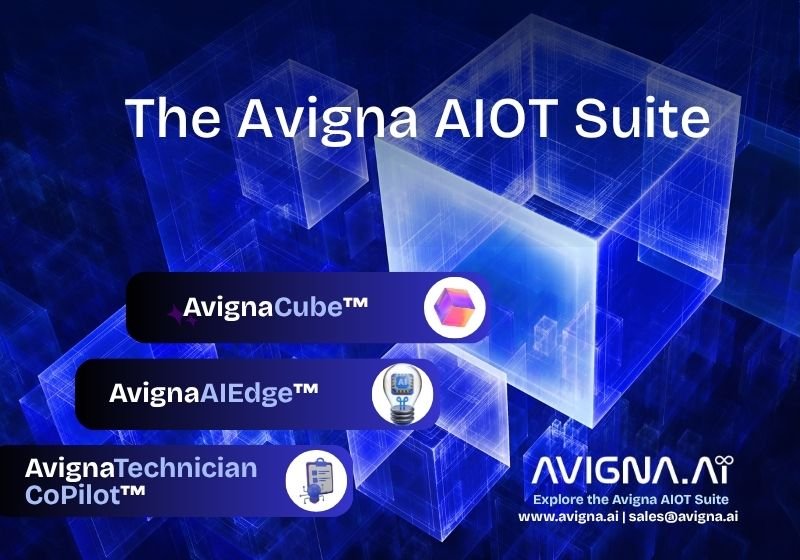
Introducing AvignaAIEdge™
At Avigna, we designed AvignaAIEdge™ to extend the Avigna AIOT architecture closer to connected equipment.
AvignaAIEdge combines hardware and software for edge data collection and processing. It connects with supported sensors, PLCs and industrial protocols, runs local processing and machine learning, and synchronises relevant insights with AvignaCube™.
The product has two hardware tiers.
AvignaAIEdge Core supports equipment connectivity, protocol translation, data collection, rules-based processing and lightweight machine learning inference.
AvignaAIEdge GPU (AI+) adds GPU-accelerated computing to support local language models, computer vision and generative AI applications at the edge, including supported use cases that need to operate offline.
Both tiers are designed to be managed centrally through AvignaCube, connecting local processing with the wider AIoT platform.
For energy providers and utilities, this architecture offers a way to consider local processing alongside centralised asset intelligence. The appropriate configuration depends on the equipment, connectivity environment, workload and operational requirements.
Bringing AI Closer to the Source
The value of edge AI is not simply that processing happens closer to a machine. It is the ability to place appropriate capabilities where they are needed, while maintaining a coherent view across the wider infrastructure.
For energy and utility organisations, that means evaluating which tasks need local processing, which insights belong in a central platform, and how both can support operational teams.
Explore AvignaAIEdge™
If your organisation is evaluating edge AI for remote assets, utility infrastructure or energy operations, contact Avigna to discuss your requirements and the role edge computing could play in your AIoT architecture.
Contact sales@avigna.ai to learn more about AvignaAIEdge™ and the Avigna AIOT Suite™.