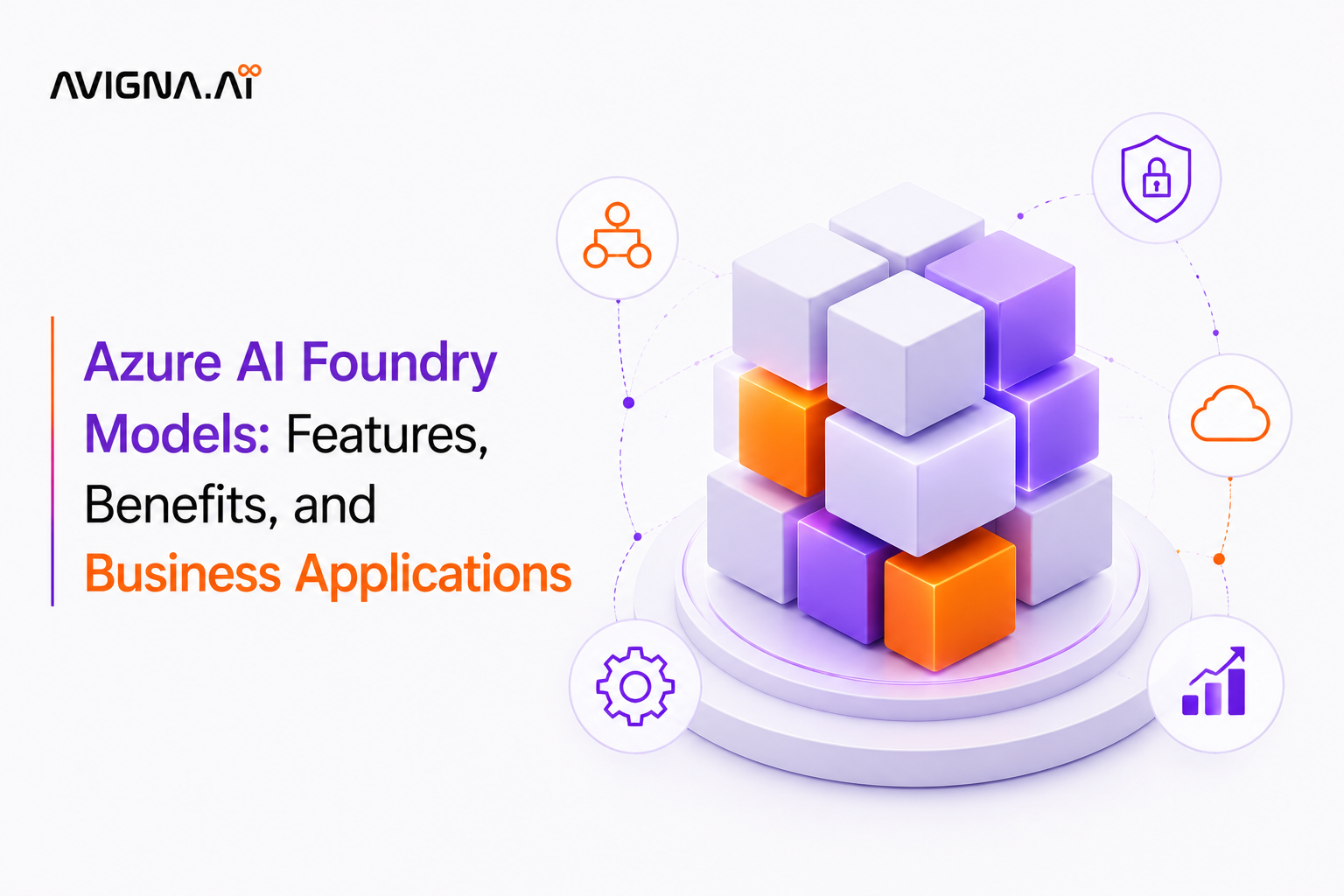
Azure AI Foundry Models: Features, Benefits, and Business Applications
Enterprise AI adoption is accelerating rapidly across industries.
Organizations are no longer experimenting with artificial intelligence solely through isolated pilots or limited automation initiatives. They are now building enterprise-scale AI ecosystems designed to improve operational efficiency, automate workflows, enhance customer experiences, and support intelligent decision-making.
However, successful AI implementation depends heavily on one critical factor:
Selecting the right AI model architecture for the business environment.
This is where Azure AI Foundry has emerged as a significant enterprise AI platform.
By providing access to multiple Large Language Models (LLMs), multimodal AI systems, orchestration frameworks, and enterprise-grade governance capabilities, Azure AI Foundry enables organizations to build scalable AI solutions aligned with real operational requirements.
For enterprise leaders, understanding the capabilities of Azure AI Foundry models is becoming increasingly important as AI transitions from experimentation to operational infrastructure.
What Is Azure AI Foundry?
Azure AI Foundry is Microsoft’s enterprise AI ecosystem designed to help organizations:
- Access foundation models
- Build AI applications
- Develop AI agents
- Integrate enterprise data
- Govern AI systems securely
- Deploy scalable AI workloads
The platform combines:
- Generative AI capabilities
- Enterprise orchestration tools
- Cloud-native infrastructure
- Security and compliance controls
- AI model management frameworks
This enables organizations to operationalize AI within enterprise environments while maintaining governance, scalability, and interoperability.
Why AI Model Selection Matters for Enterprises
Not all AI models are designed for the same operational goals.
Some models prioritize:
- Reasoning capabilities
- Speed
- Cost efficiency
- Multimodal processing
- Domain specialization
- Lightweight deployment
- Enterprise scalability
Selecting the wrong model can lead to:
- Higher infrastructure costs
- Increased latency
- Reduced response accuracy
- Governance challenges
- Poor operational performance
As enterprise AI adoption matures, organizations increasingly require model strategies aligned with:
- Business objectives
- Operational complexity
- Security requirements
- Scalability expectations
Azure AI Foundry addresses this challenge by providing access to multiple AI model categories within a unified ecosystem.
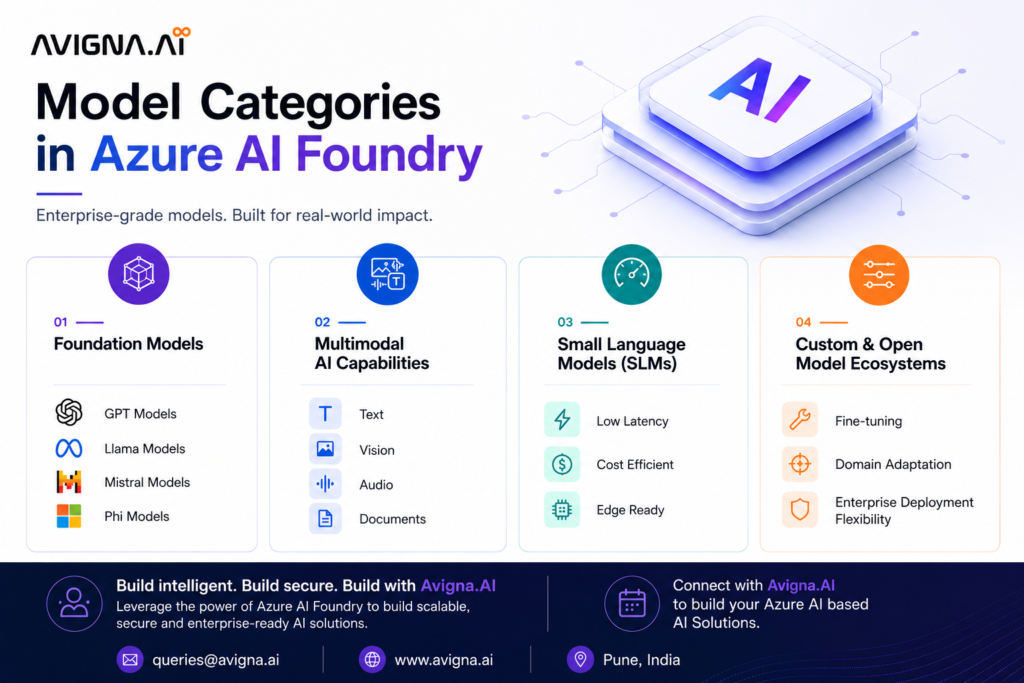
Types of Models Available in Azure AI Foundry
Azure AI Foundry supports multiple categories of AI models designed for different enterprise use cases.
Foundation Models
Foundation models are large-scale pretrained AI systems capable of handling a wide range of language and reasoning tasks.
These models support:
- Content generation
- Conversational AI
- Summarization
- Knowledge retrieval
- Enterprise automation
- Workflow orchestration
Examples include:
- GPT models
- Llama models
- Mistral models
- Phi models
Foundation models often serve as the intelligence layer behind enterprise AI agents and copilots.
Multimodal AI Models
Multimodal models can process multiple forms of data simultaneously, including:
- Text
- Images
- Audio
- Documents
- Video
These capabilities are increasingly important for:
- Manufacturing inspection systems
- Healthcare diagnostics
- Intelligent document processing
- Visual analytics
- AI-powered operational monitoring
Multimodal AI significantly expands the range of enterprise AI applications beyond text-based interactions.
Small Language Models (SLMs)
Smaller AI models are becoming increasingly important for enterprises seeking:
- Faster inference
- Lower operational costs
- Edge deployment capability
- Reduced infrastructure requirements
SLMs are particularly useful for:
- Industrial edge environments
- Real-time AI systems
- Lightweight enterprise automation
- Operational AI workloads
As AI adoption scales, cost-efficient models are becoming strategically important for enterprise deployments.
Open-Source and Customizable Models
Azure AI Foundry also enables enterprises to deploy and customize open-source models.
This provides organizations with:
- Greater flexibility
- Model customization capability
- Cost optimization options
- Industry-specific fine-tuning
For regulated industries and specialized operational environments, customization can significantly improve AI relevance and accuracy.
Key Features of Azure AI Foundry Models
Azure AI Foundry provides several enterprise-grade capabilities that differentiate it from isolated AI experimentation platforms.
| Feature | Enterprise Value |
| Model Diversity | Flexibility across use cases |
| Multimodal Processing | Supports text, image, and document intelligence |
| Retrieval-Augmented Generation (RAG) | Secure enterprise knowledge retrieval |
| Fine-Tuning Capabilities | Domain-specific optimization |
| AI Agent Integration | Workflow automation |
| Responsible AI Tooling | Governance and risk management |
| Cloud Scalability | Enterprise-scale deployment |
| Azure Integration | Native Microsoft ecosystem compatibility |
These capabilities help organizations move from fragmented AI pilots toward scalable enterprise AI ecosystems.
Business Benefits of Azure AI Foundry Models
Faster AI Deployment
Azure AI Foundry reduces the complexity of building enterprise AI systems by providing:
- Prebuilt infrastructure
- Managed AI services
- Enterprise orchestration tools
- Integrated governance controls
This accelerates AI adoption timelines.
Improved Enterprise Scalability
Many organizations struggle to scale AI beyond pilot environments.
Azure AI Foundry enables:
- Multi-team collaboration
- Centralized AI governance
- Enterprise deployment consistency
- Cross-functional AI integration
This is critical for large organizations operating across multiple business units or regions.
Enhanced Security and Governance
Enterprise AI requires strong governance frameworks.
Azure AI Foundry includes:
- Role-based access controls
- Security monitoring
- Compliance alignment
- Responsible AI tooling
- Data isolation capabilities
This is especially important for enterprises operating in regulated sectors.
Better Integration With Existing Enterprise Systems
Many enterprises already operate within Microsoft ecosystems.
Azure AI Foundry integrates with:
- Azure cloud infrastructure
- Microsoft 365
- Dynamics 365
- Enterprise databases
- Operational platforms
This reduces integration complexity and accelerates operationalization.
Greater Operational Efficiency
AI models help enterprises automate:
- Repetitive workflows
- Data processing tasks
- Customer interactions
- Knowledge retrieval
- Operational reporting
This improves productivity while allowing teams to focus on higher-value activities.
Enterprise Business Applications of Azure AI Foundry Models
The practical value of AI models emerges through business applications.
Manufacturing
Manufacturers use AI models for:
- Predictive maintenance
- Production analytics
- Quality inspection
- Operational intelligence
- Supply chain visibility
AI-driven manufacturing systems are becoming foundational to smart factory initiatives.
Healthcare
Healthcare organizations use AI models for:
- Clinical documentation
- Medical data summarization
- Intelligent patient engagement
- Administrative automation
AI helps improve efficiency while supporting faster information access.
Financial Services
Financial institutions use AI models for:
- Fraud detection
- Risk analysis
- Intelligent customer support
- Document processing
- Compliance workflows
AI-driven automation significantly improves operational responsiveness.
Logistics and Supply Chain
Supply chain organizations leverage AI models for:
- Demand forecasting
- Inventory optimization
- Shipment visibility
- Route intelligence
- Procurement analytics
Connected AI systems improve agility across complex logistics networks.
Customer Operations
Enterprises deploy AI models to support:
- Conversational AI systems
- Intelligent customer support
- Personalized experiences
- Automated knowledge retrieval
- Service operations
AI-powered customer operations are rapidly becoming enterprise standards.
How Enterprises Select the Right AI Model
AI model selection should align with operational requirements rather than industry hype.
Organizations typically evaluate:
- Accuracy
- Response speed
- Infrastructure cost
- Scalability
- Security
- Compliance
- Context handling
- Deployment environment
For example:
- Large foundation models may support advanced reasoning workflows
- Smaller models may perform better in edge environments
- Multimodal models may be necessary for document or image intelligence
Successful enterprise AI strategies often involve multiple model architectures operating together within unified ecosystems.
The Future of Enterprise AI Will Be Multi-Model
The future of enterprise AI is unlikely to revolve around a single dominant model architecture.
Instead, organizations will increasingly adopt:
- Multi-model environments
- AI orchestration systems
- Domain-specific AI workflows
- Hybrid AI infrastructures
Azure AI Foundry positions enterprises to manage this complexity through a centralized AI ecosystem capable of supporting diverse operational requirements.
As AI adoption accelerates, the ability to govern and operationalize multiple models efficiently will become a major competitive advantage.
How Avigna.AI Supports Enterprise AI Modernization
Avigna.AI helps enterprises implement scalable AI and AIoT solutions designed for modern operational environments.
By combining expertise across:
- Enterprise AI systems
- Azure ecosystems
- AI orchestration
- Cloud-native architectures
- Industrial intelligence
- Operational automation
Avigna AI enables organizations to build secure, scalable, and business-aligned AI infrastructures.
The company supports enterprises in:
- AI solution strategy
- Model integration
- Enterprise AI deployment
- Operational intelligence
- AIoT transformation
- Workflow automation
As enterprise AI ecosystems grow increasingly complex, implementation expertise becomes essential for successful operationalization.
Final Thoughts
AI adoption is entering a new phase.
Organizations are no longer evaluating AI solely as an innovation initiative. They are increasingly treating AI as enterprise operational infrastructure.
Azure AI Foundry provides organizations with the flexibility, scalability, governance, and model diversity required to support this transition.
For enterprises pursuing AI transformation, selecting the right AI model architecture is becoming as important as selecting the right cloud infrastructure or enterprise software platform.
The future competitive advantage will belong to organizations capable of integrating AI models into real operational workflows securely, intelligently, and at scale.
Frequently Asked Questions
What is Azure AI Foundry?
Azure AI Foundry is Microsoft’s enterprise AI platform for building, deploying, governing, and scaling AI applications, AI agents, and generative AI solutions.
What types of models are available in Azure AI Foundry?
Azure AI Foundry supports foundation models, multimodal models, small language models, open-source models, and customizable enterprise AI models.
What are multimodal AI models?
Multimodal AI models can process multiple data formats such as text, images, audio, and documents within a single AI system.
Why are small language models important for enterprises?
Small language models provide faster inference, lower operational costs, and improved deployment flexibility, especially for edge environments and real-time systems.
How do enterprises choose the right AI model?
Organizations evaluate AI models based on accuracy, scalability, latency, infrastructure cost, security, compliance, and operational use case requirements.