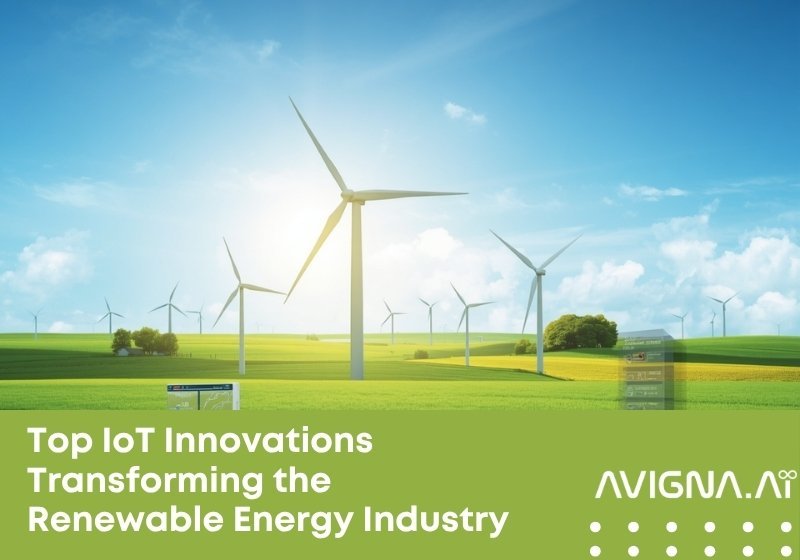
Top 5 IoT Innovations Transforming the Renewable Energy Industry
Solar farms, wind turbines, battery storage systems and distributed energy resources are expanding rapidly, but scaling renewable generation is not simply a matter of installing more assets. Operators need to continuously monitor performance, predict failures, optimize generation, manage variability and make increasingly complex operational decisions.
IoT connects physical renewable energy assets with sensors, communication networks, edge devices, cloud platforms and analytics systems. When combined with Artificial Intelligence (AI), this connected infrastructure can move renewable energy operations from periodic monitoring toward continuous, predictive and increasingly autonomous management.
Recent research describes IoT-enabled energy systems as a foundation for real-time monitoring, renewable integration, load management and smarter grid operations.
According to Mordor Intelligence, smart grid monitoring accounted for 38.10% of IoT in the energy market by application in 2025, while renewable power plants are projected to grow at a 16.05% CAGR through 2031.
So, what are the IoT innovations that are reshaping renewable energy?
Here are five worth watching.
1. IoT-Powered Real-Time Asset Monitoring
Renewable energy assets operate in environments where conditions can change continuously.
A solar plant can experience changes in irradiance, temperature, soiling and weather conditions. Wind turbines operate under changing wind speeds, loads and mechanical conditions. Battery energy storage systems must be monitored for parameters such as temperature, voltage and state of charge.
Traditional inspection schedules cannot capture every change as it happens.
IoT changes this by connecting assets to distributed sensor networks that continuously collect operational data.
Depending on the asset, sensors can capture information such as:
- Temperature
- Vibration
- Pressure
- Voltage
- Current
- Irradiance
- Wind speed
- Humidity
- Equipment status
- Energy generation
- Battery conditions
That data can then be transmitted to an IoT platform for visualization, analysis and action.
Why does real-time monitoring matter?
Because renewable energy operators do not simply need to know whether an asset is working.
They need to know how it is performing, whether its performance is changing and whether that change requires intervention.
IoT-enabled monitoring creates the visibility needed to answer those questions.
2. AI-Powered Predictive Maintenance
One of the most valuable applications of connected renewable energy data is predictive maintenance.
Instead of waiting for equipment to fail or performing maintenance solely according to a fixed schedule, AI models can analyze historical and real-time sensor data to identify patterns associated with degradation or potential faults.
Research published in 2026 identifies AI as an increasingly important technology for fault detection, degradation forecasting and performance optimization across renewable energy systems.
Consider a wind turbine.
Sensors may continuously capture vibration, temperature, rotational speed and other operational parameters.
An AI system can analyze those data streams and identify deviations from expected behavior.
The workflow can become:
Sensor data ? IoT platform ? AI analytics ? anomaly detection ? maintenance alert ? operational action
This gives maintenance teams an opportunity to investigate a developing issue before it becomes an unplanned failure.
Predictive maintenance is becoming more sophisticated
The evolution is moving from:
Monitoring ? Detection ? Prediction ? Prescription
A 2026 review of digital twins across wind, solar PV, hydropower and battery storage describes this progression toward diagnostic, prognostic, prescriptive and increasingly autonomous maintenance ecosystems.
The result is a shift from asking:
“Is this asset failing?”
to:
“What is likely to happen next, and what should we do about it?”
3. Digital Twins for Renewable Energy Assets
Digital twins are emerging as an important layer in intelligent renewable energy infrastructure.
A digital twin creates a dynamic digital representation of a physical asset, system or process and continuously updates it using real-world data.
For renewable energy, that could mean creating a digital representation of:
- A solar plant
- A wind turbine
- A battery storage system
- A microgrid
- A distributed energy resource
- An entire energy network
IoT provides the data.
AI provides analytical intelligence.
The digital twin provides a contextual representation of the physical system.
This combination can enable operators to monitor asset behavior, identify anomalies, simulate scenarios and optimize operations.
Recent research highlights digital twins as an emerging foundation for predictive maintenance and reliability enhancement across solar PV, wind, hydropower and battery storage systems.
From monitoring to simulation
The real advantage of a digital twin is that operators can potentially evaluate scenarios before implementing them in the physical environment.
For example:
- What happens if generation falls by 15%?
- What happens if a turbine component begins degrading?
- When should maintenance be scheduled?
- How will changing weather conditions affect generation?
- How should distributed energy resources respond to changing demand?
This makes the digital twin more than a visualization tool.
It becomes a decision-support layer.
4. IoT + AI for Renewable Energy Forecasting and Optimization
Renewable energy presents a fundamental operational challenge: generation is variable.
Solar generation changes with cloud cover, irradiance and time of day.
Wind generation changes with wind conditions.
This variability makes accurate forecasting and energy management increasingly important.
IoT provides the real-time data required to understand what is happening across assets.
AI can then use that information alongside historical and environmental data to improve forecasting and operational decisions.
A 2026 review of IoT-enabled intelligent energy management for photovoltaic systems highlights real-time data collection, power forecasting and smart energy management as important applications of IoT in solar generation.
A connected renewable energy environment can therefore bring together:
Asset data + weather data + historical performance + grid conditions + AI models
to support decisions around:
- Generation forecasting
- Energy dispatch
- Load management
- Storage utilization
- Grid integration
- Performance optimization
This is particularly important as renewable assets become more distributed and energy systems become more complex.
5. Edge IoT and Intelligent Grid Management
Not every decision can wait for data to travel to a centralized cloud platform.
Some renewable energy applications require rapid responses.
This is where edge computing becomes important.
Instead of sending every data point to a remote cloud environment before processing it, edge devices can process selected information closer to the asset.
For example:
Sensors ? Edge device ? Local analytics ? Immediate response
while more extensive data can continue to flow to:
Cloud IoT platform ? AI analytics ? Enterprise applications
This hybrid architecture can reduce latency and support more responsive operational control.
Recent research on IoT-enabled smart grids identifies edge computing, advanced metering infrastructure, AI-enabled predictive maintenance and digital twins among the technologies supporting modern grid operations.
Why is edge computing important for renewable energy?
Because the energy environment is increasingly distributed.
A centralized system may be managing information from:
- Solar installations
- Wind farms
- Battery storage
- Microgrids
- EV infrastructure
- Smart meters
- Distributed energy resources
Processing some information at the edge can help reduce communication dependency and support faster responses, while the cloud remains valuable for enterprise-wide analytics and long-term optimization.
The Bigger Opportunity: Connecting IoT to Intelligent Action
The five innovations above are not independent technologies.
Their real value emerges when they operate as part of an integrated architecture.
Consider a modern renewable energy environment:
Sensors – IoT Connectivity – Edge Computing – Cloud IoT Platform – AI & Predictive Analytics – Digital Twin – Enterprise Applications – Automated Workflow
This creates a continuous loop between the physical energy infrastructure and the digital systems managing it.
And that changes the role of IoT.
IoT is no longer simply about collecting data from connected equipment.
It is becoming the infrastructure through which energy assets can be observed, understood and acted upon.
The future of renewable energy is not just about generating more power; it is about making every connected asset more intelligent, predictable and responsive.
What IoT Means for Renewable Energy Companies
For renewable energy operators and equipment manufacturers, the question should not simply be:
“Where can we install IoT sensors?”
The more strategic questions are:
- What operational data are we currently missing?
- Which asset failures are most expensive?
- Where are maintenance decisions reactive?
- How accurately can we forecast generation?
- Which processes still depend on manual intervention?
- Can asset data reach the systems responsible for taking action?
- Can AI identify patterns that traditional monitoring misses?
- Can we create a digital representation of critical assets?
- Which decisions can be automated safely?
These questions shift the conversation from IoT deployment to operational intelligence.
How Avigna.AI Approaches Intelligent Renewable Energy Operations
At Avigna.AI, we see IoT as more than a connectivity layer.
The real value comes from connecting assets, data, AI and business workflows.
An enterprise IoT architecture can bring together device connectivity, edge data, real-time monitoring, analytics and AI-driven intelligence to create a unified operational view.
For renewable energy and energy-intensive organizations, this can support use cases such as:
- Real-time asset monitoring
- Predictive maintenance
- Energy performance analytics
- Anomaly detection
- Equipment health monitoring
- Generation forecasting
- Digital twins
- Workflow automation
- AI-powered operational insights
The objective is not simply to collect more data.
It is to turn operational data into decisions that improve reliability, efficiency and asset performance.
Frequently Asked Questions
What is IoT in renewable energy?
IoT in renewable energy refers to the use of connected sensors, devices, communication networks, edge computing and cloud platforms to monitor and manage renewable energy assets such as solar panels, wind turbines, batteries and distributed energy resources.
How does IoT improve renewable energy operations?
IoT provides continuous operational visibility. It can help organizations monitor asset performance, detect anomalies, support predictive maintenance, improve forecasting and connect physical assets with enterprise applications.
How is AI used with IoT in renewable energy?
AI can analyze IoT-generated data to identify anomalies, predict equipment degradation, forecast energy generation and support operational decision-making.
What is a digital twin in renewable energy?
A digital twin is a dynamic digital representation of a physical asset or energy system that is continuously informed by real-world data. It can support monitoring, simulation, fault detection, predictive maintenance and optimization.
Why is edge computing important in renewable energy?
Edge computing allows selected data processing to occur closer to connected assets. This can support faster responses and reduce dependence on sending every data point to a centralized cloud environment.
What is the role of IoT in smart grids?
IoT can connect sensors, meters, distributed energy resources and other grid infrastructure to create real-time visibility and enable more responsive monitoring, energy management and renewable integration.
Turn Renewable Energy Data Into Intelligent Action
Renewable energy infrastructure is becoming increasingly connected.
The next competitive advantage will come from what organizations do with the data generated by that connected infrastructure.
Avigna.AI helps enterprises connect operational assets, IoT data and AI-driven intelligence to create smarter, more responsive operations.
If your renewable energy infrastructure is generating data but that data is not yet driving better decisions, it may be time to build the intelligence layer around it.
Talk to Avigna.AI about building an intelligent IoT and AI architecture for your energy operations.