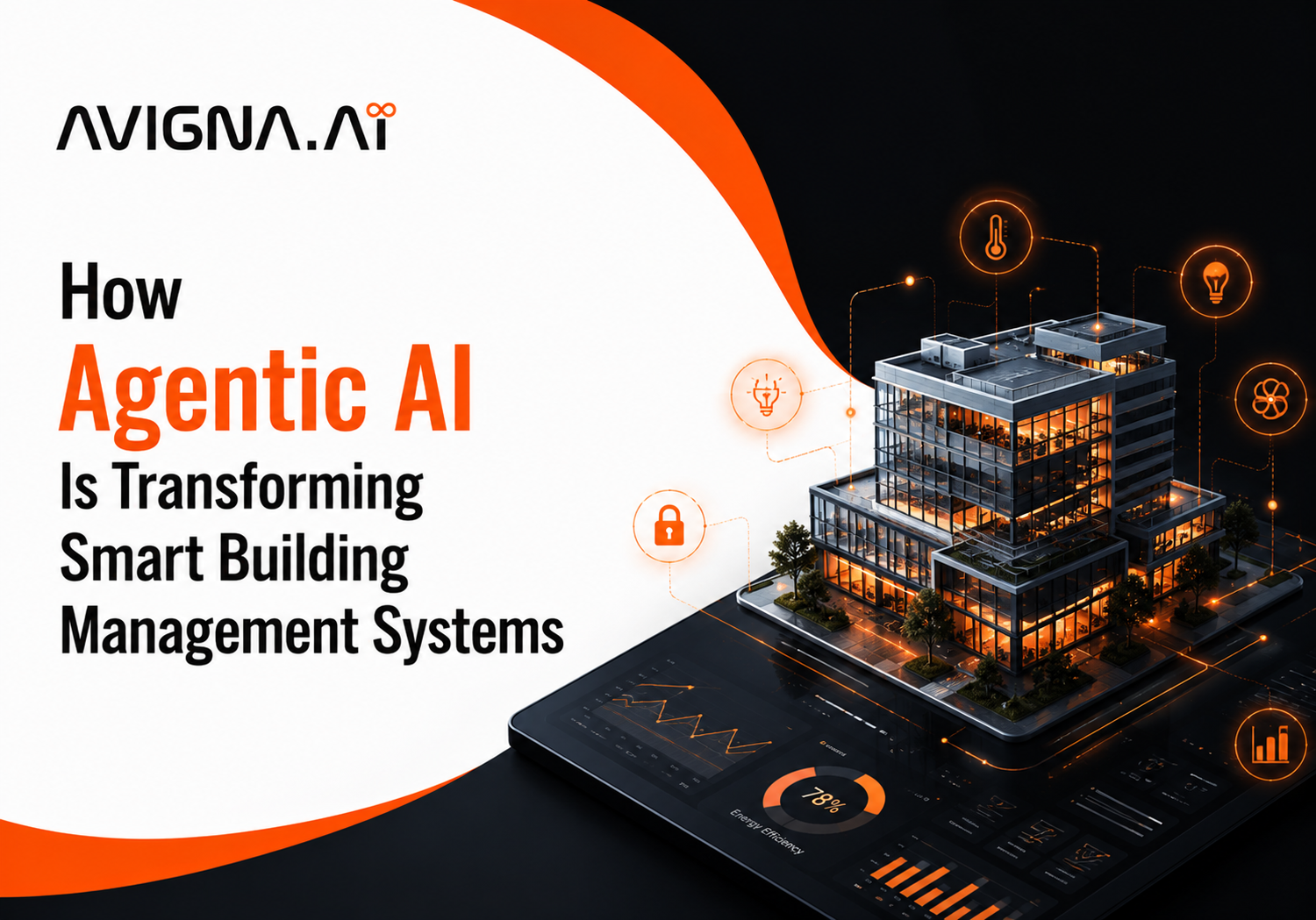
How Agentic AI Is Transforming Smart Building Management Systems
Smart buildings have evolved significantly over the last decade. Powered by IoT sensors, Building Management Systems (BMS), and cloud connectivity, modern facilities can now monitor everything from HVAC performance and lighting to occupancy, air quality, and energy consumption.
Yet, despite this technological progress, many buildings still rely on reactive workflows. Facility managers receive alerts, analyze dashboards, investigate issues, and manually decide the next course of action. While automation has improved operational efficiency, decision-making remains largely human-driven.
This is where Agentic AI for Smart Buildings is redefining intelligent building operations.
Unlike conventional AI that analyzes data or provides recommendations, Agentic AI can reason, make contextual decisions, coordinate multiple building systems, and continuously optimize operations with minimal human intervention.
The result is a new generation of AI Building Management Systems that move beyond automation to autonomous building intelligence.
What Is Agentic AI for Smart Buildings?
Agentic AI refers to intelligent AI systems capable of understanding objectives, reasoning across multiple data sources, making informed decisions, and executing actions autonomously.
Within a Smart Building Management System, Agentic AI continuously evaluates operational conditions by combining data from:
- IoT sensors
- HVAC systems
- Lighting controls
- Occupancy sensors
- Energy meters
- Security systems
- Weather forecasts
- Historical building performance
- Enterprise facility management platforms
Rather than waiting for facility managers to respond, AI agents proactively optimize building performance based on business priorities.
For example, instead of simply notifying a facility manager that HVAC energy consumption has increased, an AI agent can identify the root cause, adjust airflow, modify cooling schedules, coordinate with occupancy data, and verify whether energy performance improves.
This represents a significant evolution in Intelligent Building Management.
Why Traditional Building Automation Is No Longer Enough
Conventional Building Automation Systems (BAS) operate using predefined rules.
For example:
- If temperature exceeds a threshold, increase cooling.
- If occupancy drops below a certain level, switch off lighting.
- If equipment reports a fault, generate an alarm.
These rules work well for predictable scenarios but struggle with dynamic environments where multiple variables constantly interact.
Modern commercial buildings generate millions of operational data points every day.
Managing this complexity requires systems capable of learning, reasoning, and adapting continuously.
This is precisely where Agentic AI Building Management Systems provide value.
Instead of reacting to isolated events, AI agents evaluate the entire operational context before making decisions.
How Agentic AI Transforms Smart Building Management Systems
Autonomous HVAC Optimization
HVAC systems account for one of the largest portions of commercial building energy consumption.
Traditional systems follow fixed schedules or simple occupancy rules.
Agentic AI continuously evaluates:
- Occupancy patterns
- Indoor air quality
- Weather forecasts
- Equipment health
- Historical energy usage
- Thermal comfort levels
Using these inputs, AI agents dynamically adjust HVAC operations to improve occupant comfort while minimizing energy consumption.
The result is improved efficiency without compromising indoor environmental quality.
Intelligent Energy Management
Energy optimization has become a strategic priority for organizations pursuing operational efficiency and sustainability goals.
Agentic AI enhances Building Energy Management by:
- Forecasting demand
- Identifying energy waste
- Optimizing peak load consumption
- Coordinating renewable energy utilization
- Adjusting equipment schedules automatically
Instead of static energy reports, facility managers gain continuously optimized building performance.
Predictive Maintenance
Unexpected equipment failures increase operational costs while disrupting building services.
AI agents continuously monitor connected equipment to detect early indicators of failure.
By analyzing vibration, temperature, runtime, historical maintenance records, and sensor anomalies, Agentic AI enables predictive maintenance before failures occur.
This reduces downtime, extends equipment life, and lowers maintenance costs.
Occupant-Centric Building Operations
Modern workplaces require buildings that adapt to changing occupancy patterns.
Agentic AI continuously learns how occupants use building spaces and automatically adjusts:
- Lighting
- Ventilation
- HVAC zones
- Meeting room conditions
- Workspace utilization
This creates healthier, more comfortable environments while reducing unnecessary energy consumption.
Security and Operational Coordination
Building systems often operate independently. Security, HVAC, lighting, and access control generate valuable operational data but rarely collaborate effectively. Agentic AI coordinates these systems to improve overall building intelligence.
For example, when access control data indicates employees have left a particular floor, AI agents can automatically reduce HVAC output, adjust lighting, and optimize energy usage without manual intervention.
This is the foundation of Autonomous Building Management.

Key Benefits of AI Building Management Systems
Organizations adopting AI Building Management Systems gain benefits beyond operational efficiency.
- Reduced Energy Costs: AI agents continuously optimize energy consumption by responding to real-time conditions instead of static schedules.
- Improved Sustainability: Intelligent energy optimization supports ESG initiatives while reducing carbon emissions.
- Better Occupant Experience: Buildings become more responsive to occupant comfort through adaptive environmental controls.
- Faster Decision-Making: Facility managers spend less time analyzing dashboards and more time managing strategic priorities.
- Lower Maintenance Costs: Predictive maintenance reduces emergency repairs while extending equipment life.
- Scalable Operations: As building portfolios expand, AI agents manage increasing operational complexity without proportional increases in staffing.
The Role of IoT in Agentic AI
Agentic AI depends on high-quality operational data.
IoT sensors provide continuous visibility into building performance by monitoring:
- Temperature
- Humidity
- Occupancy
- Air quality
- Equipment health
- Energy usage
- Lighting
- Water consumption
This real-time intelligence becomes the foundation upon which AI agents make informed operational decisions.
Without connected infrastructure, autonomous building intelligence cannot exist.
Industrial IoT and Agentic AI therefore work together to create truly intelligent buildings.
The Future of Intelligent Building Management
The future of Smart Building Technology extends far beyond automation. Buildings will increasingly operate as intelligent ecosystems capable of learning, adapting, and optimizing themselves.
Rather than relying on human operators to monitor dashboards throughout the day, AI agents will continuously coordinate HVAC systems, optimize energy consumption, predict maintenance requirements, improve occupant comfort, and support sustainability initiatives.
Organizations investing in Connected Buildings today are laying the foundation for autonomous building operations tomorrow.
As AI continues to mature, the conversation will shift from “How can we automate building operations?” to “How can autonomous AI continuously improve them?”
Conclusion
Building Management Systems have served as the operational backbone of commercial buildings for decades.
However, growing operational complexity requires more than traditional automation.
Agentic AI introduces a new approach to Intelligent Building Operations by combining AI reasoning, Industrial IoT, predictive intelligence, and autonomous decision-making into smart building management systems.
The result is buildings that not only monitor performance but continuously optimize it.
For organizations seeking to improve energy efficiency, reduce operational costs, enhance occupant experiences, and build sustainable infrastructure, Agentic AI is becoming a strategic capability rather than an emerging technology.
Why Avigna.AI?
At Avigna.AI, we help organizations transform conventional Building Management Systems (BMS) into intelligent, autonomous platforms powered by Industrial IoT and Agentic AI.
Our solutions combine connected sensors, edge intelligence, AI-driven analytics, and autonomous workflows to help enterprises optimize energy consumption, improve HVAC performance, enable predictive maintenance, and build future-ready smart buildings.
Whether you’re modernizing an existing Building Automation System or developing a next-generation Smart Building Management System, Avigna AI delivers scalable solutions that turn operational data into intelligent action. Contact us today.
Frequently Asked Questions
What is Agentic AI in Smart Buildings?
Agentic AI is an advanced AI capability that autonomously analyzes building data, reasons across multiple systems, and takes intelligent actions to optimize building operations.
How does Agentic AI improve Smart Building Management Systems?
It enhances Building Management Systems by enabling autonomous HVAC optimization, predictive maintenance, intelligent energy management, and real-time operational decision-making.
What is the difference between Agentic AI smart building management systems and traditional building automation?
Traditional building automation follows predefined rules, while Agentic AI continuously learns from operational data, adapts to changing conditions, and makes contextual decisions autonomously.
Can Agentic AI reduce building energy costs?
Yes. By continuously optimizing HVAC, lighting, occupancy schedules, and energy consumption, Agentic AI helps reduce operational costs while improving sustainability.
How does Agentic AI improve HVAC efficiency?
It analyzes occupancy, weather, equipment performance, and environmental conditions to dynamically optimize HVAC operations for both comfort and energy efficiency.
What are the benefits of AI-powered Smart Building Management Systems?
Benefits include lower energy costs, predictive maintenance, improved occupant comfort, intelligent building operations, reduced downtime, and enhanced sustainability.
How does Agentic AI work with IoT sensors?
IoT sensors provide real-time operational data that AI agents analyze to monitor building conditions, identify optimization opportunities, and automate intelligent actions.
Can Agentic AI and smart building management systems improve predictive maintenance?
Yes. AI agents detect early signs of equipment degradation using sensor data and historical performance trends, enabling maintenance before failures occur.