What Separates Connected Systems from Intelligent Operations? Azure AI Foundry
Over the last decade, enterprises have made measurable progress in connecting assets, devices, and systems. From factory floors to supply chains, Azure IoT solutions have enabled real-time data collection at scale.
However, connectivity alone does not translate into operational excellence.
Research from Gartner and IDC consistently highlights a gap between data availability and decision-making effectiveness. Many organizations have visibility into operations, yet continue to experience delays, inefficiencies, and reactive responses.
This raises a more important question than adoption:
What differentiates a connected system from an intelligent operation?
Connected systems vs intelligent operations: a structural distinction
The difference lies not in infrastructure, but in how data is used.
| Capability | Connected Systems | Intelligent Operations |
| Data collection | Continuous | Continuous |
| Visibility | High | High |
| Insight type | Descriptive | Predictive and prescriptive |
| Decision-making | Human-driven | AI-assisted or automated |
| Response time | Delayed | Near real-time |
| Business impact | Monitoring-focused | Outcome-driven |
Why most IoT initiatives plateau after deployment
Despite strong technical foundations, many Azure IoT solutions fail to progress beyond the monitoring stage.
This plateau is typically characterized by:
- Dependence on dashboards for interpretation
- Threshold-based alerts rather than predictive signals
- Manual intervention in critical workflows
- Limited integration between insights and execution systems
According to IoT Analytics, a significant number of IoT projects struggle to scale because they do not move beyond visibility into actionable intelligence.
The issue is not the absence of data. It is the absence of embedded intelligence.
Azure AI Foundry: enabling the transition to intelligent operations
To move beyond this plateau, organizations need to integrate AI directly into their operational architecture.
Azure AI Foundry, within the broader ecosystem of Microsoft Azure AI solutions, enables this transition by introducing:
- Real-time model inference on streaming IoT data
- Continuous learning and model updates
- Direct integration of predictions into operational systems
Instead of analyzing data after the fact, systems begin to respond as data is generated.
From rule-based systems to learning systems
Traditional industrial environments rely heavily on rule-based logic. While effective in stable scenarios, these systems struggle with complexity and variability.
| Aspect | Rule-Based Systems | AI-Driven Systems (Azure AI Foundry) |
| Logic | Predefined rules | Learned from historical and real-time data |
| Adaptability | Limited | High |
| Pattern detection | Threshold-based | Contextual and multi-variable |
| Scalability | Constrained | Scales across systems and environments |
A report by McKinsey notes that AI-enabled operations significantly outperform rule-based systems in areas such as predictive maintenance and process optimization.
A practical lens: how intelligent operations change outcomes
Consider a logistics environment where shipments are monitored using IoT sensors.
In a connected system:
- Data is captured in real time
- Delays are visible on dashboards
- Teams respond after disruptions occur
In an intelligent operation:
- AI models predict potential delays based on patterns
- Alternative routes or actions are recommended instantly
- Decisions are executed with minimal manual intervention
The shift is subtle in design but significant in outcome.
Organizations move from responding to events to anticipating them.
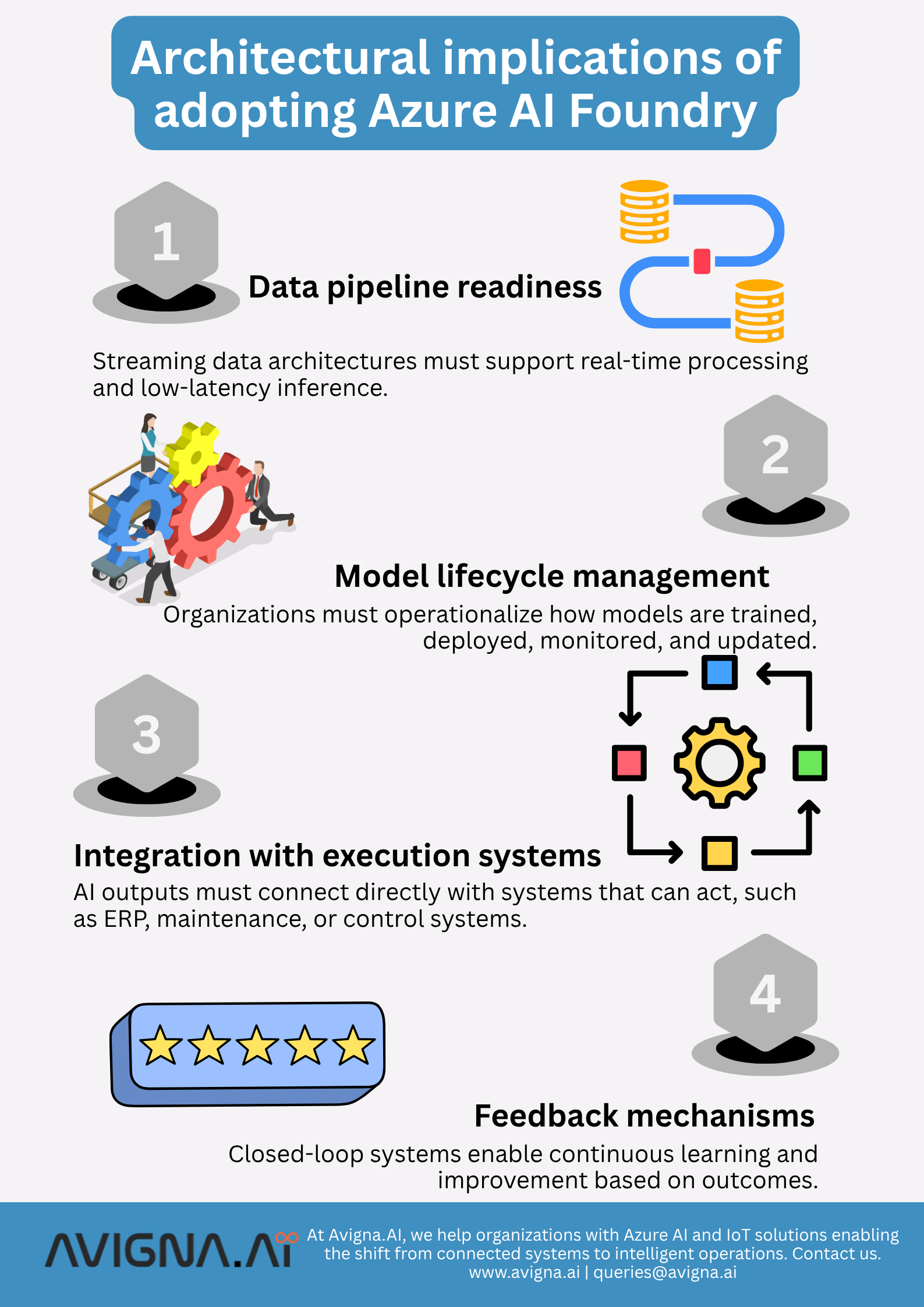
Architectural implications of adopting Azure AI Foundry
Embedding intelligence into IoT systems requires alignment across multiple layers:
- Data pipeline readiness
Streaming data architectures must support real-time processing and low-latency inference.
- Model lifecycle management
Organizations must operationalize how models are trained, deployed, monitored, and updated.
- Integration with execution systems
AI outputs must connect directly with systems that can act, such as ERP, maintenance, or control systems.
- Feedback mechanisms
Closed-loop systems enable continuous learning and improvement based on outcomes.
According to Forrester, organizations that establish such feedback-driven AI systems achieve higher operational maturity and faster value realization.
Business impact: why this shift matters
The transition from connected systems to intelligent operations is not incremental. It directly influences performance metrics that matter to leadership.
| Metric | Connected Systems | Intelligent Operations |
| Decision speed | Moderate | High |
| Operational efficiency | Incremental improvement | Significant improvement |
| Downtime reduction | Reactive | Proactive |
| Automation level | Limited | Scalable |
| ROI realization | Gradual | Accelerated |
This is where Azure AI Foundry becomes a strategic enabler rather than an optional enhancement.
FAQs
What is the difference between connected systems and intelligent operations?
Connected systems focus on collecting and visualizing data, while intelligent operations use AI to generate predictive insights and enable automated or assisted decision-making.
How does Azure AI Foundry enhance Azure IoT solutions?
Azure AI Foundry enables real-time analytics, predictive modeling, and decision automation, allowing IoT systems to move beyond monitoring into actionable intelligence.
Why do IoT projects often fail after initial deployment?
Many projects stop at the visibility stage due to lack of AI integration, resulting in limited business impact and unclear ROI.
What industries benefit from intelligent operations?
Industries such as manufacturing, logistics, energy, and infrastructure benefit due to their reliance on real-time data and operational efficiency.
Is AI necessary for scaling IoT solutions?
Yes. AI is essential for enabling predictive insights and automation, which are critical for scaling IoT beyond monitoring.
Conclusion
The distinction between connected systems and intelligent operations is becoming increasingly relevant as organizations scale their digital initiatives. Connectivity has laid the foundation. The next phase requires systems that can interpret, predict, and act. By integrating Azure AI Foundry with existing Azure IoT solutions, enterprises can move toward operational models where data is not only visible, but actionable in real time.
Moving Beyond Connectivity
Most organizations today have already established connected environments. The opportunity now lies in identifying where intelligence can be embedded to improve speed, efficiency, and outcomes.
At Avigna.AI, we work with B2B and technology-driven organizations to position and communicate advanced solutions such as Azure AI Foundry and Azure IoT with clarity and strategic depth.
If you are evaluating how to evolve from connected systems to intelligent operations, we can help you define the right approach and narrative. Schedule your free consultation.