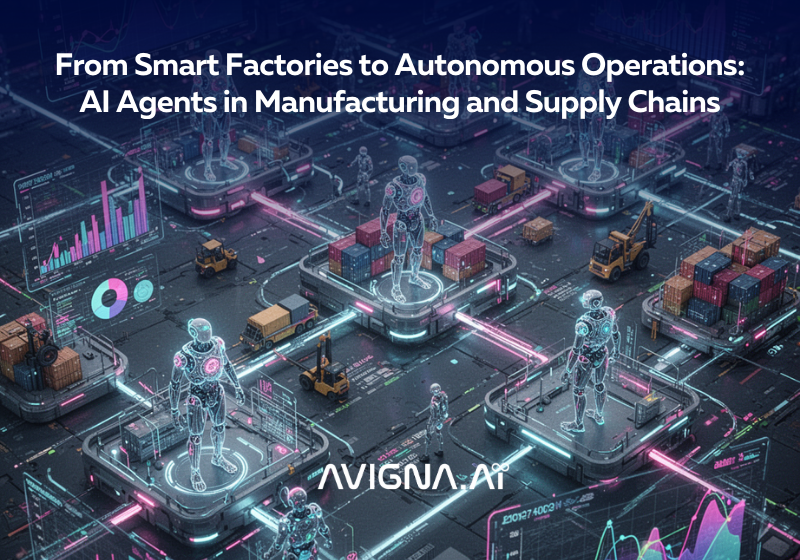
From Smart Factories to Autonomous Operations: AI Agents in Manufacturing and Supply Chains
In the first wave of smart manufacturing, the industrial world learned how to see. Factories were instrumented with industrial IoT sensors, machines were connected to cloud platforms, dashboards proliferated across control rooms, and executives could, often for the first time, observe real-time performance across geographically dispersed production networks. Visibility, long elusive in complex operations, was finally achieved.
Yet visibility, however sophisticated, does not in itself constitute intelligence. What is now unfolding across advanced manufacturing environments and supply chain ecosystems is a deeper transition with AI Agents in Manufacturing and Supply Chains, from connected awareness to autonomous coordination, from descriptive analytics to agent-driven execution, and from static planning cycles to continuously self-adjusting operational systems.
The Limits of the Smart Factory
The smart factory paradigm, rooted in Industry 4.0 principles, established a robust perception layer: cyber physical systems, machine telemetry, RFID-based tracking, and real-time production monitoring formed the digital nervous system of industrial operations.
However, the decision layer frequently remained human-centric, dependent on planners, supervisors, and logistics managers who, despite improved data access, were still required to interpret signals and manually recalibrate schedules, routes, and maintenance priorities.
In stable environments, this hybrid model proved adequate. In volatile contexts characterized by demand variability, fluctuating energy tariffs, supplier disruptions, labor constraints, and sustainability mandates, it reveals its limitations.
Manufacturing scheduling, multi-echelon inventory planning, and dynamic vehicle routing are not merely operational tasks; they are combinatorial optimization problems whose complexity scales exponentially. As variables multiply, even highly experienced teams encounter diminishing marginal effectiveness in manual orchestration.
It is precisely within this combinatorial domain that AI agents emerge as a transformative mechanism.
The Architecture of Industrial AI Agents
An industrial AI agent is not a dashboard enhancement, nor a statistical forecasting module appended to an ERP system. It is an autonomous decision entity embedded within a cyber physical architecture, continuously executing a perception-prediction-prescription-actuation cycle.
Such an agent ingests high-frequency telemetry from machines, production lines, warehouse systems, and fleet networks; forecasts near-term states using machine learning and reinforcement learning models; simulates alternative decisions across constrained operational spaces; optimizes against multiple objectives such as throughput, cost, energy intensity, and service-level adherence; and executes commands through integrated control systems, all while learning from the consequences of prior actions.
This closed-loop execution framework marks the departure from reactive management to adaptive autonomy.

Manufacturing: From Static Schedules to Dynamic Sequencing
Consider the classical job-shop scheduling problem, an NP-hard optimization challenge in which machines, materials, labor availability, and delivery commitments interact in a tightly constrained environment.
Traditional planning systems generate schedules at defined intervals, often daily or weekly, and rely on manual adjustments when disruptions occur. In contrast, AI agents operating within smart factories can continuously re-sequence production orders in response to real-time machine performance, material delays, or energy pricing shifts, thereby minimizing idle time and improving overall equipment effectiveness without additional capital expenditure.
Moreover, the integration of energy-aware production planning introduces a new dimension to operational intelligence. As energy markets become increasingly volatile and sustainability metrics assume board-level importance, AI agent-based systems can modulate production loads, align high-consumption processes with favorable tariff windows, and balance emissions targets against throughput objectives.
The factory thus evolves from a scheduled entity to a self-optimizing organism.
Predictive Maintenance as Coordinated Optimization
Predictive maintenance, once heralded as a breakthrough in industrial AI, often remains confined to alert generation, predicting when a component is likely to fail but leaving intervention timing to human discretion.
Agent-driven maintenance architectures extend beyond prediction into prescriptive coordination. They evaluate failure probability in conjunction with production commitments, simulate the downstream impact of equipment downtime, allocate workforce resources, and schedule maintenance within windows that minimize disruption.
The result is not merely fewer failures, but a systematic reduction in variance across operational performance.
Supply Chains: Toward Self-Healing Networks
If factories represent the controlled environment of industrial production, supply chains represent its distributed, stochastic counterpart, where uncertainty is endemic and interdependencies span continents.
The introduction of supply chain control towers brought end-to-end visibility; yet, in many organizations, decision-making remains centralized and episodic. AI agents embedded across logistics networks can recompute routing strategies in response to real-time traffic data, reassign warehouse slotting dynamically based on inbound variability, coordinate autonomous mobile robots within fulfillment centers, and balance carbon emissions against delivery timelines using multi-objective optimization.
Vehicle routing under uncertainty, long studied within operations research, becomes tractable at scale when reinforcement learning models continuously adapt dispatch policies based on streaming data. The network ceases to be merely observable and becomes self-correcting.
In such environments, resilience is not reactive recovery but proactive adaptation.

The Role of Digital Twins
Autonomous operations require validation mechanisms capable of evaluating policy decisions before physical execution. Digital twins, high-fidelity simulations of production lines, warehouses, or entire logistics networks, provide precisely this capability.
Within these simulated environments, AI agents can test alternative scheduling policies, stress-test capacity constraints, and model extreme disruption scenarios without jeopardizing live operations. The digital twin functions as a sandbox for operational evolution, reducing implementation risk while accelerating learning cycles.
In effect, it institutionalizes experimentation within industrial governance.
Governance and the Question of Control
Autonomy, if improperly structured, introduces legitimate concerns regarding oversight, compliance, and accountability. The acceleration of agent-driven execution must therefore be accompanied by embedded governance architectures, including human-in-the-loop controls, policy enforcement layers, audit trails, and explainability frameworks.
Rather than constraining autonomy, such mechanisms stabilize it, ensuring that optimization does not compromise safety, regulatory adherence, or ethical standards. The future of industrial AI will not be defined by unrestrained automation, but by structured autonomy aligned with enterprise governance.
Beyond Smart: The Emergence of Autonomous Operations
The progression from smart factories to autonomous operations represents more than technological maturation; it signals a philosophical shift in industrial management. Where once data visibility was the objective, now continuous optimization is the standard. Where once human planners absorbed complexity, now AI agents manage it at machine speed.
In manufacturing and supply chains increasingly characterized by volatility, sustainability imperatives, and global interdependence, static planning is a structural disadvantage. Autonomous operations offer a mechanism for absorbing variability while preserving efficiency.
The factories and supply networks that embed agent-driven intelligence responsibly, integrating industrial IoT, digital twins, reinforcement learning, and multi-objective optimization within governed architectures, will not simply operate more efficiently; they will operate more resiliently.
The question confronting industrial leaders is therefore not whether AI agents will shape manufacturing and supply chains, but how deliberately and architecturally sound their adoption will be.
Schedule a free consultation
If your organization is evaluating AI agents, industrial IoT adoption, or the transition toward autonomous operations, we invite you to consult with us. We work with manufacturing and supply chain leaders to design governed, scalable architectures that move beyond visibility into measurable execution outcomes. Connect with us to discuss how agent-driven intelligence and IoT can be structured to deliver resilience, efficiency, and long-term operational advantage.