AIoT Is Not a Trend. It Is the New Operating Layer for Industrial Systems
The conversation around AI and IoT has matured. What was once positioned as “AI + IoT integration” is now evolving into something more fundamental.
AIoT is no longer an enhancement layer. It is becoming the operating layer.
Across manufacturing, logistics, and infrastructure, enterprises are moving beyond connected systems toward environments where data is continuously interpreted, decisions are dynamically generated, and actions are increasingly automated.
According to IDC and IoT Analytics, organizations that combine AI with IoT at scale are not just improving efficiency. They are redefining how operations are executed.
From IoT systems to AIoT environments
Traditional Internet of Things architectures were designed with a clear purpose: collect and transmit data.
AIoT changes that purpose.
Instead of simply enabling visibility, AIoT systems are designed to:
- Interpret complex, high-frequency data streams
- Identify patterns that are not explicitly defined
- Trigger decisions in real time
This is where concepts such as AI Agents in IoT and Agentic AI in IoT become relevant.
These are not abstract ideas. They represent a shift toward systems that can:
- Observe
- Reason
- Act
What defines an AIoT operating layer
An AIoT operating layer integrates intelligence directly into the flow of operations.
It is not a separate analytics module. It is embedded across the system.
Core characteristics of AIoT
- Continuous intelligence: Models operate in real time, not in batches
- Autonomous decision support: Systems generate recommendations or actions without waiting for manual input
- Context awareness: Decisions are based on multiple data sources, not isolated signals
- Scalability: Intelligence scales across devices, locations, and processes
These agents act as decision-making units within the system, capable of handling specific operational scenarios such as anomaly detection, resource optimization, or predictive maintenance.
The emergence of Agentic AI in IoT systems
The introduction of Agentic AI in IoT represents a structural evolution.
Unlike traditional AI models that provide outputs, agentic systems are designed to:
- Take goals as input
- Evaluate multiple possible actions
- Execute decisions within defined constraints
Practical interpretation
In an industrial environment:
- A traditional IoT system reports a temperature spike
- A standard AI model predicts potential failure
- An agentic AI system evaluates:
- Severity
- Production schedules
- Maintenance availability
- Cost implications
And then recommends or executes the most optimal action.
According to Gartner, agent-based AI systems are expected to play a significant role in enterprise automation over the next few years, particularly in complex operational environments.
Where AIoT is already reshaping industries
AIoT is not theoretical. It is actively redefining operational models across sectors.
Manufacturing
- Predictive maintenance using AI-driven pattern recognition
- Production optimization through adaptive, self-correcting systems
- Quality inspection using computer vision
Logistics & Supply Chain
- Dynamic routing based on real-time and predictive conditions
- Inventory optimization using demand forecasting
- Fleet monitoring with AI-driven risk and efficiency insights
Energy & Utilities
- Load balancing using predictive analytics
- Fault detection across distributed infrastructure
- Smart grid optimization and energy demand forecasting
Healthcare
- Remote patient monitoring with real-time alerts
- Predictive diagnostics using connected medical devices
- Asset tracking in hospitals for operational efficiency
Retail
- Smart shelves with real-time inventory tracking
- Personalized in-store experiences using behavioral data
- Demand sensing and automated replenishment
A report from McKinsey highlights that AI-driven industrial operations can significantly reduce downtime and improve throughput when integrated effectively with IoT systems.
AI Agents in IoT: from concept to implementation
The concept of AI Agents in IoT is central to scaling AIoT systems. These agents function as modular intelligence units within the architecture.
Their role includes:
- Monitoring specific signals or systems
- Running specialized models
- Making localized decisions
- Communicating with other agents or central systems
Simplified comparison of IoT + AI and AIOT
| Aspect | Traditional IoT + AI | AIoT with AI Agents |
| Intelligence Architecture | Centralized models processing aggregated data | Distributed intelligence embedded at edge and across systems |
| Decision Model | Sequential (data ? cloud ? insight ? action) | Parallel, autonomous, and event-driven decisions |
| Latency & Responsiveness | Dependent on cloud round-trips | Near real-time, edge-enabled responsiveness |
| Scalability | Constrained by centralized compute and pipelines | Scales horizontally via autonomous agents |
| Operational Adaptability | Rule-based, reactive adjustments | Self-learning, context-aware adaptation |
| Resilience | Vulnerable to single points of failure | Decentralized, fault-tolerant decision layers |
| Business Impact | Visibility and monitoring | Continuous optimization and autonomous operations |
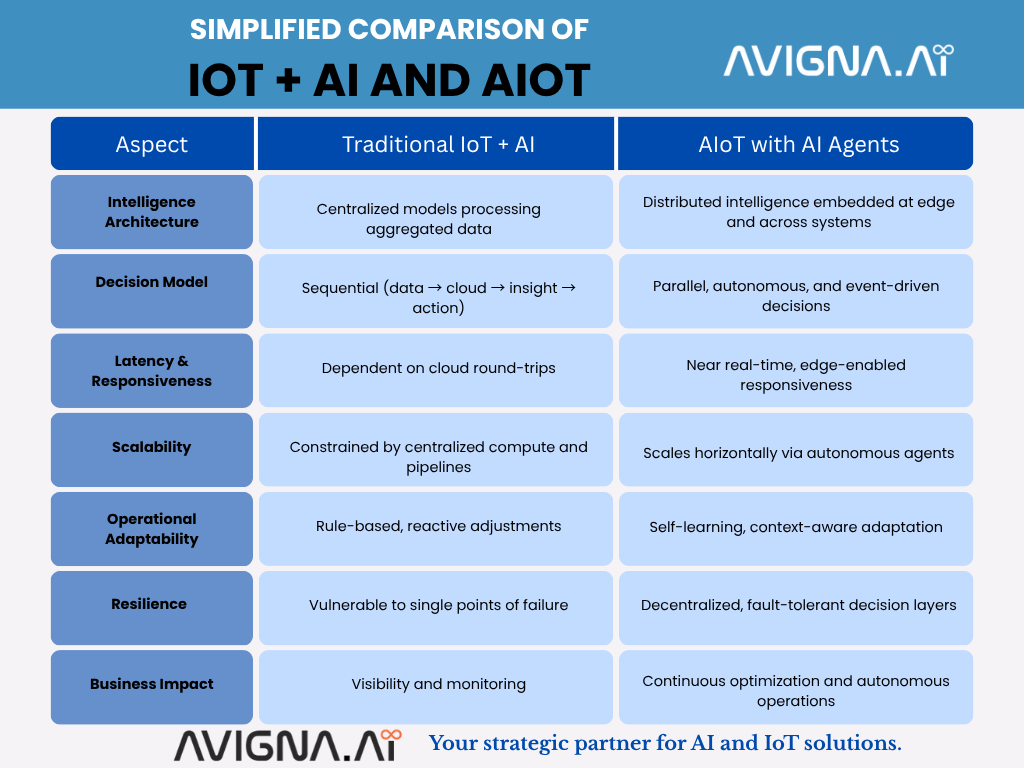
This distributed intelligence model aligns closely with how modern enterprises operate across multiple locations and systems.
Why AIoT is becoming the default architecture
The transition toward AIoT is driven by practical constraints:
- Increasing data volumes that cannot be manually interpreted
- Need for faster decision-making in competitive environments
- Complexity of systems that cannot be managed through static rules
Key drivers
- Real-time operational requirements
- Cost pressures and efficiency mandates
- Workforce limitations in high-skill decision roles
As a result, organizations are moving toward systems where intelligence is embedded, not added later.
Strategic considerations for adopting AIoT
Adopting AIoT requires more than deploying models. It requires rethinking system design.
- Data architecture
Ensure data pipelines support real-time processing and integration across sources.
- Agent design
Define how IoT AI agents will operate, interact, and scale.
- Governance
Establish clear boundaries for automated decision-making and accountability.
- Integration
Connect AI outputs with execution systems to enable real impact.
According to Forrester, organizations that treat AI as an operational capability rather than a standalone function achieve significantly better outcomes.
Business impact: what changes with AIoT
| Dimension | Traditional IoT | AIoT |
| Decision speed | Delayed | Near real-time |
| Operational efficiency | Incremental | Significant |
| Automation | Limited | Scalable |
| Insight quality | Descriptive | Predictive and prescriptive |
| ROI realization | Slow | Accelerated |
FAQs
What is AIoT and how is it different from IoT?
AIoT combines artificial intelligence with IoT to enable systems that can analyze data, make decisions, and act in real time, rather than just collecting and displaying data.
What are AI Agents in IoT?
AI Agents in IoT are autonomous or semi-autonomous components that monitor data, run models, and make decisions within specific operational contexts.
What is Agentic AI in IoT?
Agentic AI in IoT refers to AI systems that can evaluate multiple options and take actions based on defined goals, rather than simply providing predictions.
Why is AIoT important for industrial systems?
AIoT enables faster decision-making, reduces downtime, improves efficiency, and allows systems to operate proactively rather than reactively.
How do IoT AI agents improve scalability?
IoT AI agents distribute intelligence across systems, enabling parallel decision-making and reducing dependency on centralized processing.
Conclusion
The evolution from IoT to AIoT is not a trend cycle. It is a structural shift in how industrial systems are designed and operated. Organizations that continue to treat AI as an add-on will remain limited by manual interpretation and delayed decisions. Those that adopt AIoT as an operating layer will move toward systems that are adaptive, responsive, and continuously improving.
Defining Your AIoT Strategy
We beleive AIoT Is Not a Trend. AIoT adoption is not about adding more technology. It is about identifying where intelligence can be embedded to drive measurable outcomes. At Avigna.AI, we work with technology-led organizations with implementing AIoT, AI Agents in IoT, and Agentic AI in IoT with clarity and strategic direction. If you are evaluating how AIoT fits into your product or platform, we can help you define and implement that transition effectively. Contact Us.