Can AI Copilots Reduce Energy Costs in Commercial Buildings?
Energy has become one of the largest operational expenses for commercial buildings. Whether it’s office complexes, hospitals, airports, retail centers, hotels, or manufacturing facilities, rising utility costs continue to pressure facility managers to do more with less.
While Building Management Systems (BMS) and IoT sensors have significantly improved visibility into building performance, many organizations still struggle to convert operational data into measurable energy savings. Dashboards provide insights, alerts identify anomalies, and reports summarize performance, but the responsibility for making decisions often remains with facility teams.
Rather than simply presenting information, AI copilots assist facility managers by analyzing building data, identifying optimization opportunities, recommending corrective actions, and continuously supporting operational decisions. The result is smarter buildings that consume less energy while improving occupant comfort and operational efficiency.
What Is an AI Copilot for Commercial Buildings?
An AI Copilot is an intelligent assistant that works alongside facility managers, building operators, and energy teams to improve decision-making.
Unlike traditional energy management software, AI copilots combine machine learning, real-time analytics, IoT data, and operational knowledge to deliver contextual recommendations rather than static reports.
Within an AI-powered building management environment, an AI copilot can:
- Monitor HVAC performance
- Identify energy waste
- Recommend operational improvements
- Detect abnormal equipment behavior
- Forecast energy demand
- Support maintenance planning
- Answer operational queries using natural language
Instead of replacing facility managers, AI copilots augment their expertise by surfacing actionable insights faster than manual analysis.
Why Energy Costs Continue to Rise in Commercial Buildings
Commercial buildings generate enormous amounts of operational data.
Every day, building systems monitor:
- HVAC equipment
- Lighting
- Occupancy
- Indoor air quality
- Chillers
- Pumps
- Elevators
- Electrical systems
- Water consumption
Yet many facilities still operate on fixed schedules, reactive maintenance, and manual optimization.
This creates several challenges:
- HVAC systems running in unoccupied spaces
- Simultaneous heating and cooling
- Equipment operating below optimal efficiency
- Delayed response to faults
- Peak demand penalties
- Unnecessary energy consumption
Without intelligent decision support, valuable energy-saving opportunities often go unnoticed.

How AI Copilots Reduce Commercial Energy Costs
Intelligent HVAC Optimization
HVAC systems account for the largest share of energy consumption in most commercial buildings.
An AI Copilot for commercial buildings continuously evaluates:
- Occupancy patterns
- Indoor temperature
- Outdoor weather
- Humidity
- Equipment health
- Historical energy trends
Instead of relying on fixed operating schedules, the AI copilot recommends dynamic adjustments that improve comfort while reducing energy use.
This approach enables commercial HVAC optimization without compromising occupant experience.
Real-Time Energy Optimization
Energy usage changes throughout the day.
AI copilots monitor building performance continuously and identify opportunities to reduce consumption by:
- Adjusting equipment schedules
- Identifying abnormal energy spikes
- Optimizing lighting usage
- Managing peak electricity demand
- Coordinating renewable energy sources
This creates a more responsive approach to building energy optimization.
Predictive Maintenance
Equipment inefficiencies often increase energy consumption long before failures become visible.
AI copilots analyze sensor data to detect:
- Excessive vibration
- Temperature anomalies
- Runtime deviations
- Performance degradation
Instead of waiting for breakdowns, maintenance teams receive early recommendations that improve equipment reliability while reducing unnecessary energy use.
Predictive maintenance also extends equipment life and minimizes costly downtime.
Occupancy-Based Building Operations
Modern workplaces no longer follow predictable occupancy patterns.
Meeting rooms remain empty.
Hybrid work changes office utilization.
Seasonal demand fluctuates.
AI copilots continuously analyze occupancy data and recommend adjustments to lighting, ventilation, and HVAC operations based on actual building usage rather than predefined schedules. This significantly improves building energy efficiency.
Intelligent Energy Reporting
Traditional reports explain what happened yesterday.
AI copilots explain:
- Why energy consumption increased
- Which systems contributed most
- What actions should be taken
- Expected impact of each recommendation
This allows facility managers to prioritize improvements based on measurable business outcomes rather than assumptions.
Beyond Cost Savings
While reducing energy costs is a major objective, organizations adopting Smart Building AI often realize additional operational benefits.
Better Occupant Comfort
AI copilots balance energy efficiency with indoor environmental quality by continuously monitoring comfort conditions.
Faster Decision-Making
Facility managers spend less time interpreting dashboards and more time implementing improvements.
Improved Sustainability
Lower energy consumption directly contributes to carbon reduction goals and ESG initiatives.
Smarter Facility Management
AI copilots support AI in facility management by consolidating operational intelligence into a single decision-support platform.
The Role of IoT and Digital Twins
AI copilots rely on accurate operational data. IoT sensors provide continuous visibility into building conditions by monitoring:
- Energy consumption
- Equipment health
- Occupancy
- Air quality
- Temperature
- Lighting
- Water usage
Many organizations are also combining AI with Digital Twin Technology to simulate building performance before implementing operational changes.
By creating a virtual representation of a building, facility teams can evaluate different optimization strategies, predict energy outcomes, and minimize operational risks.
Together, IoT, digital twins, and AI copilots create a powerful foundation for Intelligent Building Operations.
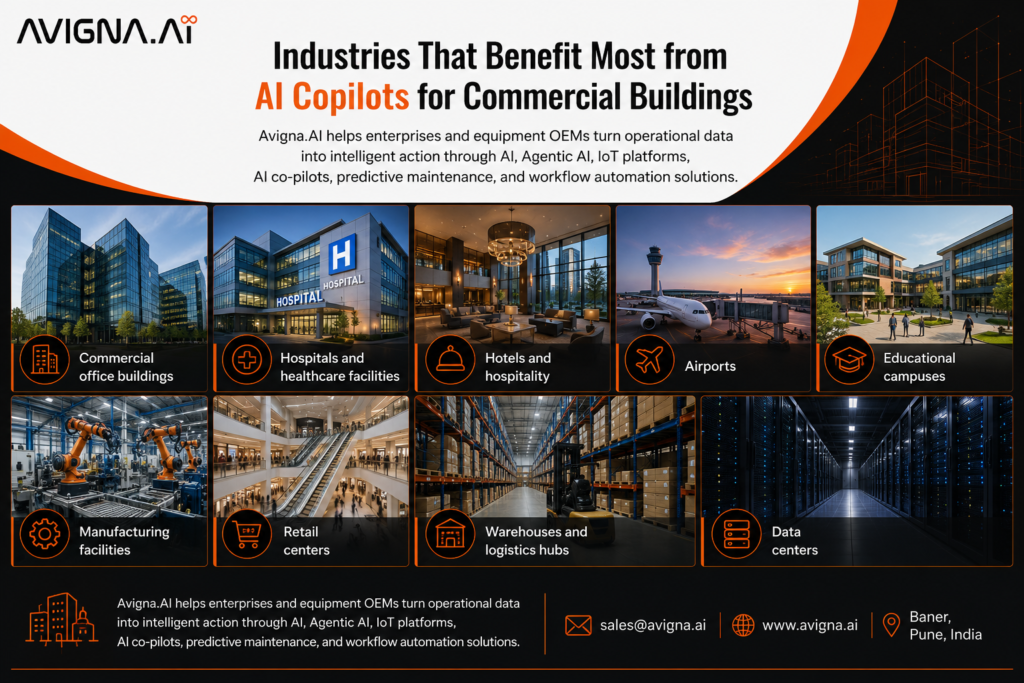
Industries That Benefit Most from Ai Copilots for Commercial Buildings
AI copilots are delivering measurable value across multiple sectors, including:
- Commercial office buildings
- Hospitals and healthcare facilities
- Hotels and hospitality
- Airports
- Educational campuses
- Manufacturing facilities
- Retail centers
- Warehouses and logistics hubs
- Data centers
Any organization operating large commercial facilities can benefit from intelligent energy optimization.
The Future of AI-Powered Building Management
Commercial buildings are evolving from connected infrastructure to intelligent ecosystems.
The next generation of AI Building Management Systems will not only monitor building performance but actively assist operators in making better decisions every day.
AI copilots represent an important step in this evolution by enabling facility managers to move from reactive operations to continuous optimization.
As energy prices continue to rise and sustainability goals become increasingly important, organizations that embrace AI-powered decision support will be better positioned to improve operational efficiency while reducing long-term costs.
Conclusion
Reducing commercial energy costs is no longer just about installing efficient equipment. It requires intelligent systems capable of understanding building behavior, identifying optimization opportunities, and supporting operational decisions in real time.
AI copilots deliver exactly that. By combining IoT, advanced analytics, predictive maintenance, and intelligent recommendations, they help organizations transform energy management from a reactive function into a strategic advantage.
For commercial building owners and facility managers, AI copilots are quickly becoming an essential component of future-ready building operations.
Build Smarter, More Energy-Efficient Buildings with Avigna.AI
At Avigna AI, we help organizations transform traditional building management into intelligent, data-driven operations through AI copilots, Industrial IoT, and advanced building automation.
Our AI-powered solutions enable facility managers to optimize HVAC performance, improve energy efficiency, reduce operational costs, and make faster decisions using real-time building intelligence.
Whether you’re modernizing an existing Building Management System (BMS) or planning a next-generation Smart Building Management System, Avigna.AI helps you unlock measurable improvements in efficiency, sustainability, and operational performance. Schedule a free consultation today.
Frequently Asked Questions
What is an AI Copilot?
An AI Copilot is an intelligent assistant that helps facility managers analyze building data, identify optimization opportunities, and make informed operational decisions.
How does AI reduce energy costs?
AI analyzes real-time building data, optimizes HVAC schedules, identifies energy waste, predicts equipment failures, and recommends actions that reduce unnecessary energy consumption.
Can AI optimize HVAC systems?
Yes. AI continuously adjusts HVAC operations based on occupancy, weather conditions, indoor air quality, and equipment performance to improve comfort while minimizing energy usage.
Is AI useful for commercial buildings?
Absolutely. AI improves energy efficiency, predictive maintenance, occupant comfort, and operational decision-making across commercial buildings.
How does AI improve building efficiency?
By monitoring connected building systems, identifying inefficiencies, recommending corrective actions, and supporting intelligent facility management.
Can AI reduce electricity bills?
Yes. AI helps reduce electricity costs by optimizing energy consumption, managing peak demand, and eliminating operational inefficiencies.
What industries benefit from AI energy management?
Commercial offices, hospitals, hotels, airports, educational institutions, retail centers, manufacturing facilities, logistics hubs, and data centers all benefit from AI-driven energy management.
What is AI-powered facility management?
AI-powered facility management combines AI, IoT, analytics, and building automation to improve operational efficiency, reduce costs, enhance occupant comfort, and support intelligent building operations.