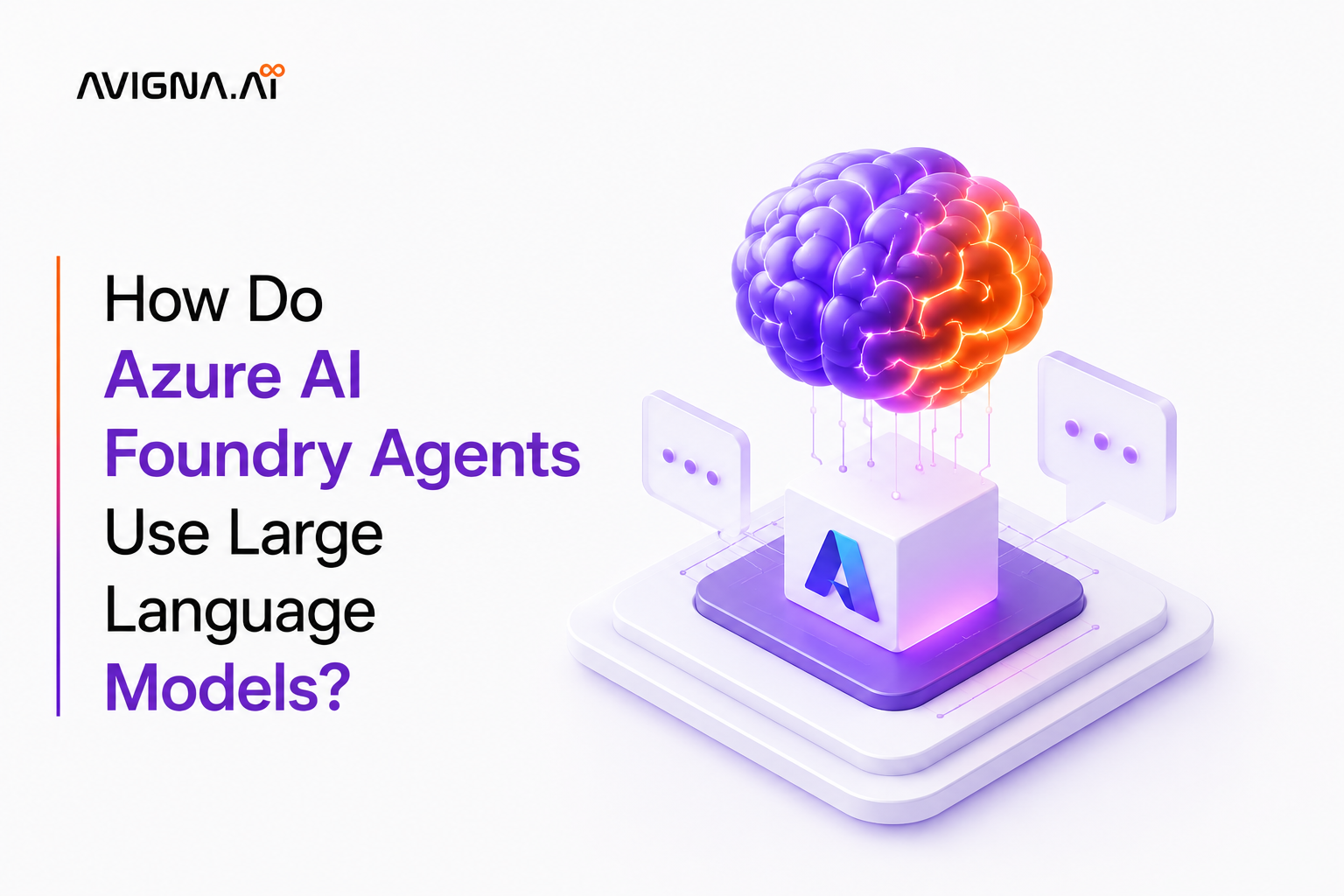
How Do Azure AI Foundry Agents Use Large Language Models?
Enterprise AI is evolving beyond chatbots. Organizations are now building intelligent systems capable of reasoning, planning, retrieving enterprise knowledge, interacting with software platforms, and automating business workflows with minimal human intervention. At the center of this transformation are AI agents.
Microsoft’s Azure AI Foundry introduces a framework for building enterprise-grade AI agents powered by Large Language Models (LLMs), enabling organizations to operationalize generative AI across real business environments. For enterprises exploring AI modernization initiatives, an important question emerges:
How do Azure AI Foundry agents actually use Large Language Models?
The answer lies in how LLMs function as the reasoning and orchestration layer behind intelligent enterprise workflows.
The Shift From AI Assistants to AI Agents
Traditional AI assistants primarily respond to prompts. AI agents go significantly further.
They can:
- Understand intent
- Retrieve information
- Execute actions
- Interact with enterprise systems
- Coordinate workflows
- Maintain contextual awareness
- Support decision-making processes
Instead of simply generating responses, AI agents operate as intelligent software entities capable of assisting across operational and business processes.
This shift is transforming how enterprises approach:
- Automation
- Customer engagement
- Operational intelligence
- Knowledge management
- Enterprise productivity
What Is Azure AI Foundry?
Azure AI Foundry is Microsoft’s enterprise AI development ecosystem designed to help organizations build, customize, govern, and deploy AI applications and AI agents at scale.
It provides enterprises with:
- Access to foundation models
- AI orchestration capabilities
- Agent frameworks
- Prompt engineering tools
- Retrieval systems
- Security and governance controls
- Integration with enterprise infrastructure
Azure AI Foundry enables organizations to operationalize generative AI within secure enterprise environments while maintaining scalability and governance.
Understanding Large Language Models (LLMs)
Large Language Models are advanced AI systems trained on vast datasets to understand and generate human language.
LLMs can:
- Interpret natural language
- Generate content
- Summarize information
- Answer questions
- Perform reasoning tasks
- Analyze context
- Generate code
- Interact conversationally
Models such as:
- GPT
- Llama
- Phi
- Mistral
are examples of LLMs commonly used within enterprise AI ecosystems.
However, within Azure AI Foundry, LLMs do not operate in isolation.
They function as the cognitive engine behind AI agents.
How Azure AI Foundry Agents Use Large Language Models
Azure AI Foundry agents use LLMs to perform five primary functions within enterprise environments.
1. Natural Language Understanding
LLMs enable AI agents to understand human instructions conversationally.
Instead of relying on rigid commands or predefined workflows, users can interact naturally using business language.
For example:
A supply chain manager might ask:
“Show me delayed shipments impacting production this week.”
The LLM interprets:
- Intent
- Business context
- Operational terminology
- Required data sources
This creates more intuitive enterprise interactions.
2. Reasoning and Decision Support
LLMs provide reasoning capabilities that allow agents to process context and determine appropriate next steps.
An AI agent may:
- Analyze multiple data points
- Evaluate operational conditions
- Recommend actions
- Prioritize workflows
- Trigger automated responses
In enterprise environments, this enables AI systems to support more intelligent decision-making processes.
For example:
- Manufacturing anomaly detection
- Customer escalation handling
- Inventory optimization
- IT operations management
The LLM acts as the reasoning engine behind these workflows.
3. Enterprise Knowledge Retrieval
One of the most valuable enterprise use cases for AI agents is retrieving internal organizational knowledge.
Azure AI Foundry agents often integrate with:
- Enterprise databases
- Document repositories
- ERP systems
- CRM platforms
- Knowledge bases
- Operational systems
Using Retrieval-Augmented Generation (RAG), agents can:
- Search enterprise knowledge
- Retrieve relevant information
- Ground responses in trusted business data
This allows organizations to use private enterprise data securely without retraining foundation models.
4. Tool and API Orchestration
AI agents built within Azure AI Foundry can interact with external systems through APIs and software integrations.
This allows agents to:
- Retrieve operational data
- Update records
- Trigger workflows
- Execute tasks
- Interact with enterprise applications
For example, an AI agent may:
- Receive a natural language request
- Query an ERP system
- Analyze production data
- Generate insights
- Trigger an operational workflow
The LLM coordinates the orchestration logic required for these interactions.
5. Contextual Memory and Multi-Step Workflows
Enterprise tasks rarely occur in a single interaction.
Azure AI Foundry agents use LLMs to maintain contextual continuity across workflows.
This allows agents to:
- Track previous interactions
- Maintain conversational context
- Support multi-step business processes
- Improve user experiences
As AI agents become more sophisticated, contextual memory becomes increasingly important for enterprise productivity applications.
The Enterprise Architecture Behind Azure AI Foundry Agents
Azure AI Foundry agents typically operate within a layered enterprise architecture.
Core Architecture Components
| Layer | Function |
| User Interface | Human interaction layer |
| AI Agent Layer | Workflow orchestration |
| Large Language Models | Reasoning and language intelligence |
| Retrieval Systems | Enterprise knowledge access |
| APIs & Integrations | Enterprise system connectivity |
| Security & Governance | Access control and compliance |
This architecture allows enterprises to operationalize AI while maintaining scalability, security, and governance.
Why Enterprises Are Investing in AI Agents
Enterprise AI adoption is accelerating because organizations increasingly require systems capable of augmenting human operations at scale.
AI agents can help:
- Reduce manual workloads
- Accelerate information access
- Improve operational efficiency
- Automate repetitive processes
- Enhance customer experiences
- Support data-driven decision-making
According to Gartner, generative AI is expected to significantly influence enterprise software architecture over the coming years, particularly through AI-powered automation and intelligent operational systems.
AI agents represent one of the most practical pathways for operationalizing generative AI inside enterprise environments.

Security and Governance in Azure AI Foundry
Enterprise AI systems require far more than model performance.
Organizations must also address:
- Data privacy
- Access governance
- Compliance
- Responsible AI policies
- Observability
- Auditability
Azure AI Foundry includes enterprise-grade governance capabilities such as:
- Role-based access control
- Responsible AI tooling
- Security monitoring
- Azure compliance frameworks
- Model evaluation systems
- Data isolation mechanisms
This is particularly important for enterprises operating in regulated industries.
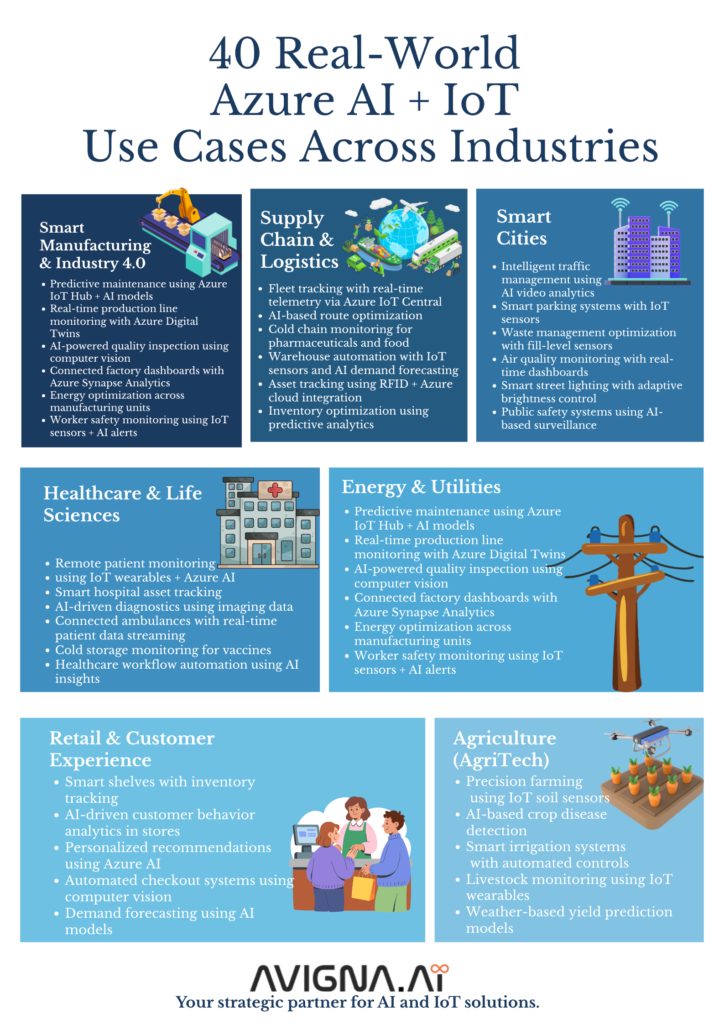
Real-World Enterprise Use Cases
Azure AI Foundry agents are increasingly being applied across industries.
Manufacturing
- Production intelligence
- Predictive maintenance workflows
- Quality monitoring
Healthcare
- Clinical document summarization
- Intelligent patient support systems
Supply Chain
- Logistics coordination
- Inventory optimization
- Procurement automation
Customer Operations
- AI-powered service automation
- Intelligent support systems
- Knowledge retrieval assistants
Enterprise IT
- Incident management
- Internal workflow automation
- Operational analytics
The flexibility of Azure AI Foundry enables organizations to build industry-specific AI workflows aligned with operational requirements.
How Avigna.AI Supports Enterprise AI Transformation with Azure AI
Avigna AI helps enterprises design and implement scalable AI and AIoT solutions aligned with modern operational and business transformation goals.
By combining expertise across:
- Enterprise AI systems
- Cloud platforms
- Industrial intelligence
- AI orchestration
- IoT integration
- Operational analytics
Avigna.AI enables organizations to operationalize intelligent workflows using enterprise-grade AI ecosystems. We support businesses in building:
- AI-powered operational systems
- Intelligent automation workflows
- Connected AIoT environments
- Enterprise AI integrations
- Scalable cloud-native AI architectures
As enterprises move from experimentation toward AI operationalization, implementation expertise becomes increasingly critical to long-term success.
A Look Into the Future
Large Language Models are becoming foundational to enterprise AI systems.
However, their greatest enterprise value emerges when integrated into intelligent agent architectures capable of reasoning, retrieving knowledge, orchestrating workflows, and interacting with enterprise systems.
Azure AI Foundry provides enterprises with the infrastructure required to build these next-generation AI systems securely and at scale.
For organizations pursuing AI transformation, AI agents represent a major shift from isolated generative AI experimentation toward operational intelligence embedded directly into business processes.
The future of enterprise AI will not be defined solely by models. It will be defined by intelligent systems capable of turning enterprise data, workflows, and operational context into real-time business action. Contact us to discuss Azure Foundry based AI systems for your business.
Frequently Asked Questions
What are Azure AI Foundry agents?
Azure AI Foundry agents are AI-powered systems built within Microsoft’s Azure AI ecosystem that can understand requests, retrieve information, interact with enterprise systems, and automate workflows using Large Language Models.
How do AI agents use Large Language Models?
AI agents use LLMs for natural language understanding, reasoning, contextual analysis, workflow orchestration, and enterprise knowledge retrieval.
What is Retrieval-Augmented Generation (RAG)?
RAG is a framework that allows AI systems to retrieve relevant enterprise information from external data sources before generating responses.
Can Azure AI Foundry agents connect with enterprise systems?
Yes. Azure AI Foundry agents can integrate with APIs, databases, ERP systems, CRM platforms, and enterprise applications.
Why are enterprises investing in AI agents?
Organizations use AI agents to improve productivity, automate workflows, accelerate information access, enhance customer experiences, and operationalize generative AI across enterprise environments.