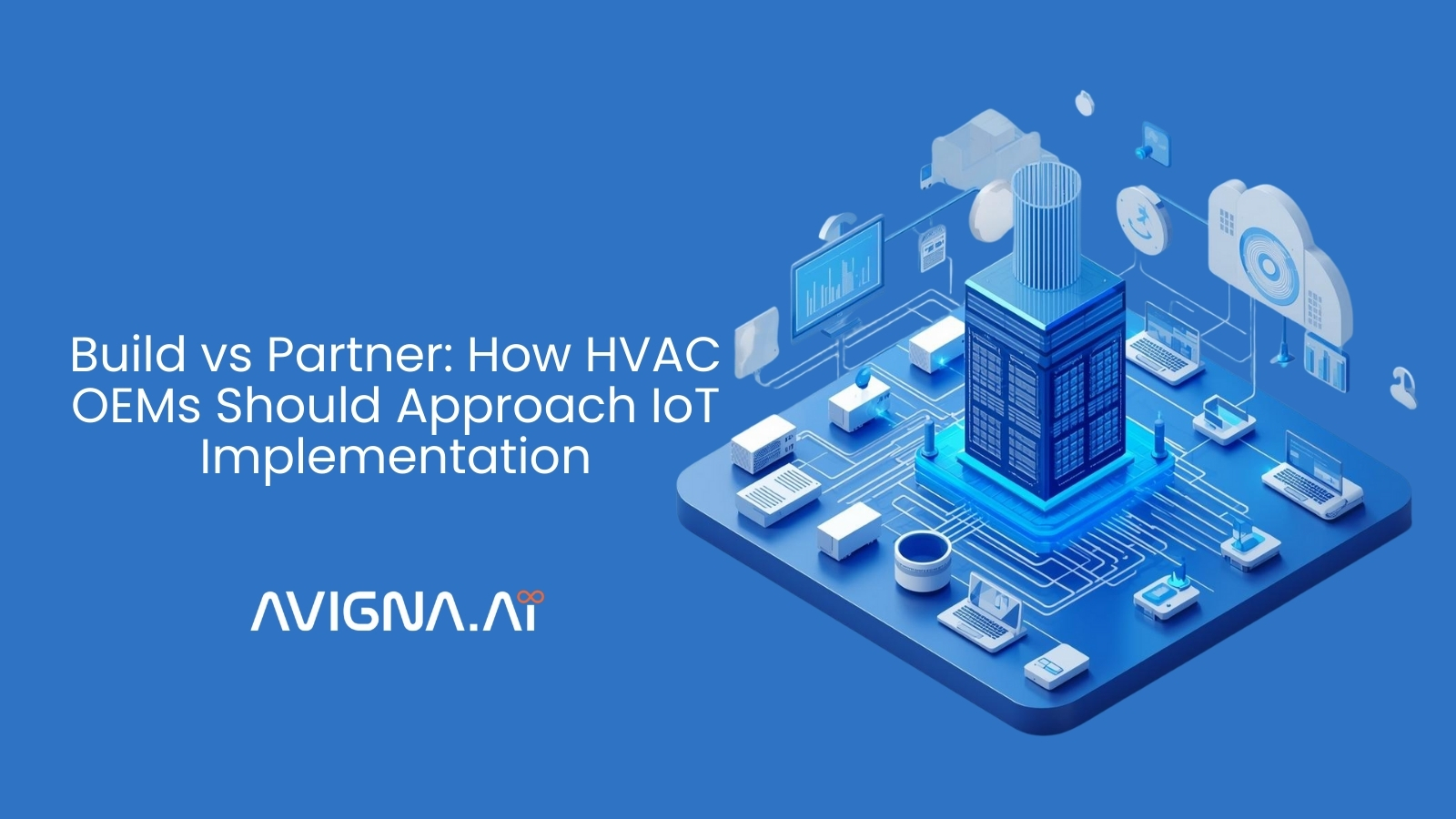
Build vs Partner: How HVAC OEMs Should Approach IoT Implementation
The “build vs partner” decision for HVAC OEMs IoT implementation is not binary. It is a strategic trade-off between control, speed, cost, and differentiation. As a rule, the faster you want reliable outcomes at fleet scale, the more you should favor a partner-led or buy+build approach. Industry practitioners and platform vendors consistently recommend hybrid approaches for enterprise IoT programs.
What each path really means
| Path | Pros | Cons |
| Build (in-house) | Full control, IP ownership | Time-consuming, requires broad skills |
| Buy (turnkey) | Faster launch, managed platform | Less flexibility, vendor lock-in risk |
| Buy + Build (hybrid) | Faster core + custom differentiation | Requires integration capability |
When to build
Consider building when:
- Your product experience is core IP (e.g., unique control algorithms)
- You have mature cloud, security, and device engineering teams
- Time-to-market is not urgent
When to partner (buy or hybrid)
Consider partnering when:
- You need to get to global scale quickly
- You lack device lifecycle or platform ops expertise
- You want predictable SLAs and security posture
IoT projects often fail when organizations underestimate platform operational requirements: device identity, secure provisioning, patching, SIM management, and analytics model lifecycle. These are expensive to build and keep secure.
Expert decision framework (five questions to decide)
- Is the capability strategic IP? If yes, build only the differentiating layers.
- Do we need speed to market? If yes, favor buy or hybrid.
- Can we staff and run platform ops for the next 5–10 years? If no, partner.
- Which integrations are non-negotiable (ERP, service, parts)? If many, ensure partner API maturity.
- What is the TCO over 5 years vs the cost of delayed monetization? Build the business case.
Practical vendor selection checklist
| Criterion | Why it matters |
| Device lifecycle ops | Critical for low-touch scale |
| Security & PKI | Regulatory and safety risk |
| Integration APIs | Close loop with service & ERP |
| Model Ops support | Maintain and retrain FDD models |
| SLAs & local support | Global rollouts need regional coverage |
Cost and time tradeoffs
- Building platform core: 12–24 months and significant engineering cost.
- Buying a platform and integrating: 3–9 months to pilot and 6–12 months to scale.
Multiple industry analyses recommend a hybrid (buy+build) route to reduce time-to-value while preserving differentiation.
Governance and organizational readiness
IoT success requires clear ownership and a governance model:
- Steering committee (product, operations, legal, finance)
- Program lead with P&L responsibility for connected services
- SRE/Platform Ops for device and platform SLAs
- Data science + model ops responsible for FDD and performance models
Roadmap example (practical timeline)
- Month 0–3: Outcome definition, vendor selection, pilot site prep
- Month 3–6: Pilot deployment, baseline data collection, initial models
- Month 6–12: Integration to service and dispatch, automate onboarding
- Month 12–24: Regional rollout, ops maturity, commercial service offers
Market signal and news context
Industry trend reports and IoT platform vendors continue to emphasize hybrid approaches and the need for enterprise-grade platform capabilities to scale IoT with security and manageability. The AHR Expo and similar industry events increasingly highlight applied analytics and operational outcomes for HVAC and building systems — a sign the market is moving from connectivity to execution.
How to pick an IoT implementation partner or IoT consulting partner
- Ask for references at comparable scale and geography.
- Request to see device onboarding flows and remote diagnostic screenshots.
- Validate integration APIs with your ERP and service system on a sandbox.
- Check their model ops and retraining process for FDD and predictive maintenance.
- Negotiate exit & data portability terms — you should own your telemetry and models.
Differentiators that matter in partners
- Proven global device lifecycle operations at scale
- Domain experience in HVAC and building operations
- Ability to embed analytics into service workflows (not just dashboards)
- Clear implementation playbook and regional support
Key takeaways
- The right approach is contextual: buy core platform services, build domain differentiation.
- Verify partner maturity on device lifecycle and model ops before signing contracts.
- Treat IoT as an operational program, not a one-off software project.
FAQs
Is it always faster to buy? Generally yes for platform services; differentiation still needs to be built.
- How do we avoid vendor lock-in? Insist on data export standards and APIs.
- Can we switch later from partner to in-house? Yes, if your contracts and data portability are planned.
- What’s the biggest hidden cost? Platform ops and device lifecycle management.
- Do we need an IoT consulting partner? If you lack in-house experience across device, connectivity, security, and analytics, yes.
If you are evaluating whether to build internally or work with an IoT implementation partner for HVAC and industrial use cases, we are open to a conversation.