Your IoT Stack Is Lying to You. Azure AI Foundry Makes It Tell the Truth.
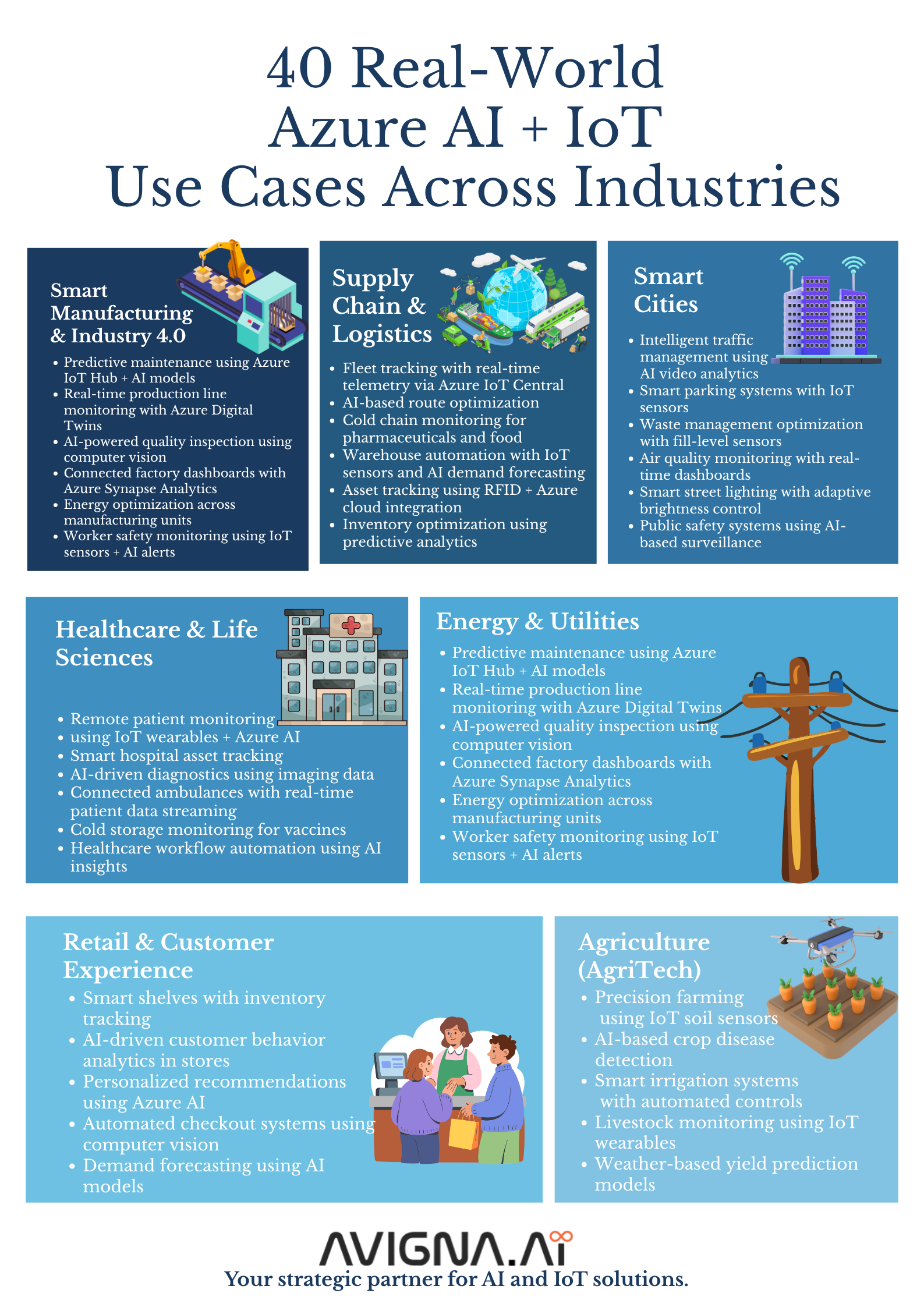
Over the past decade, enterprises have invested significantly in IoT infrastructure. Connected devices, cloud ingestion pipelines, and visualization layers are now standard across industries such as manufacturing, logistics, and energy. However, a consistent gap remains between data availability and decision-making.
Industry research from McKinsey and IoT Analytics indicates that while IoT adoption has increased steadily, a large percentage of initiatives struggle to deliver measurable business value beyond monitoring and reporting. The core issue is not data collection. It is the absence of embedded intelligence within operational workflows.
This is where Azure AI Foundry, as part of broader Microsoft Azure AI solutions, introduces a meaningful shift.
Understanding Azure IoT solutions and the role of Azure AI Foundry
A typical Azure IoT solutions architecture includes:
- Device connectivity through Azure IoT Hub
- Data ingestion into cloud storage or streaming pipelines
- Visualization via dashboards and BI tools
This architecture is effective in answering descriptive questions such as:
- What is the current system status?
- Where are anomalies occurring?
However, it is less effective in addressing predictive and prescriptive questions:
- What is likely to happen next?
- What action should be taken immediately?
Azure AI Foundry complements this architecture by enabling the development and deployment of AI models that operate directly within these data flows.
Functional distinction
| Capability | Azure IoT Solutions | Azure AI Foundry |
| Data ingestion | Yes | No |
| Device management | Yes | No |
| Predictive modeling | Limited | Core capability |
| Real-time inference | Limited | Yes |
| Decision automation | No | Yes |
From monitoring to decision intelligence
Traditional IoT systems are designed for visibility. Modern systems must be designed for decision intelligence.
This transition involves embedding AI models into operational pipelines rather than treating analytics as a downstream function.
Key differences in approach
| Dimension | Traditional IoT | AI-enabled IoT with Azure AI Foundry |
| Primary focus | Monitoring | Decision-making |
| Response model | Reactive | Predictive and prescriptive |
| Human involvement | High | Reduced and targeted |
| Scalability of decisions | Limited | High |
A report by Gartner highlights that organizations focusing on real-time decision intelligence achieve significantly higher operational efficiency compared to those relying solely on dashboards and alerts.
Why dashboards alone are insufficient
Dashboards remain a critical component of enterprise systems, but they are inherently limited.
They require:
- Human interpretation
- Contextual judgment
- Manual action
In high-frequency environments such as manufacturing or logistics, even small delays in interpretation can lead to inefficiencies or losses.
For example:
- A temperature anomaly in industrial equipment may appear on a dashboard immediately
- The actual decision to intervene may take minutes or hours
An AI-driven system, in contrast, can:
- Detect patterns beyond predefined thresholds
- Predict potential failure before it occurs
- Trigger or recommend corrective action instantly
How Azure AI services enable real-time intelligence in IoT
Azure AI services, when combined with Azure AI Foundry, enable organizations to operationalize machine learning at scale.
Core capabilities include:
- Predictive analytics: Forecasting equipment failure, demand fluctuations, or system anomalies
- Anomaly detection: Identifying deviations in complex, high-dimensional data streams
- Prescriptive recommendations: Suggesting optimal actions based on predicted outcomes
Example: Predictive maintenance workflow
| Stage | Traditional Approach | AI-Enabled Approach |
| Detection | Threshold-based alerts | Pattern-based anomaly detection |
| Analysis | Manual investigation | Automated root cause analysis |
| Decision | Scheduled maintenance | Dynamic intervention |
| Outcome | Reduced downtime | Prevented downtime |
According to Forrester, organizations that embed AI into operational processes, rather than limiting it to analytics functions, report higher ROI and faster time-to-value.
Architectural considerations for implementing Azure AI Foundry
Integrating Azure AI Foundry into an existing IoT ecosystem requires careful planning across multiple dimensions.
- Data readiness
High-quality, well-structured data is essential for reliable model performance.
- Model lifecycle management
Organizations must establish processes for:
- Model training
- Validation
- Deployment
- Continuous monitoring
- Integration with enterprise systems
AI-driven outputs must connect seamlessly with:
- ERP systems
- Maintenance platforms
- Operational control systems
- Governance and scalability
As AI becomes embedded in decision-making, governance frameworks become critical to ensure:
- Accuracy
- Accountability
- Compliance
Common pitfalls in Azure IoT and AI adoption
Despite strong technology foundations, many organizations encounter challenges such as:
| Challenge | Impact |
| Over-reliance on dashboards | Limited decision impact |
| Lack of AI integration | Underutilized data |
| Siloed data environments | Incomplete insights |
| Absence of automation | Delayed responses |
Addressing these gaps requires a shift in both architecture and mindset.
FAQs
What is Azure AI Foundry in the context of IoT?
Azure AI Foundry is a platform that enables enterprises to build and deploy AI models that can process IoT data in real time, enabling predictive insights and automated decision-making.
How do Azure AI services enhance Azure IoT solutions?
Azure AI services provide capabilities such as machine learning, anomaly detection, and predictive analytics, which transform IoT data into actionable intelligence.
Why is decision intelligence important in IoT systems?
Decision intelligence reduces response time, improves operational efficiency, and enables proactive interventions, which are not possible with monitoring systems alone.
Which industries benefit most from Azure AI + IoT integration?
Industries such as manufacturing, logistics, energy, and smart infrastructure benefit significantly due to their need for real-time insights and operational optimization.
What are the key challenges in implementing Azure AI Foundry?
Key challenges include data quality, model lifecycle management, system integration, and governance. Addressing these areas is essential for successful deployment.
Conclusion
IoT has successfully addressed the challenge of connectivity and data collection. The next phase of evolution lies in making that data operationally meaningful.
By integrating Azure AI Foundry with existing Azure IoT solutions, organizations can move beyond monitoring and reporting toward predictive and prescriptive decision-making.
This shift is not merely technological. It represents a fundamental change in how enterprises operate, compete, and scale.
Turning IoT Data into Measurable Outcomes
Most organizations today have already invested in IoT infrastructure. The real question is whether that investment is translating into faster decisions, reduced risk, and operational efficiency.
If your current systems are still centered around monitoring, it may be time to evaluate how AI can be embedded directly into your workflows.
At Avigna.AI, we work with technology and industrial companies to position, communicate, and scale advanced solutions such as Azure AI Foundry and Azure IoT in a way that drives real business impact.
If you are exploring how to move from connected systems to intelligent operations, we can help you. Book a free discovery call with us.