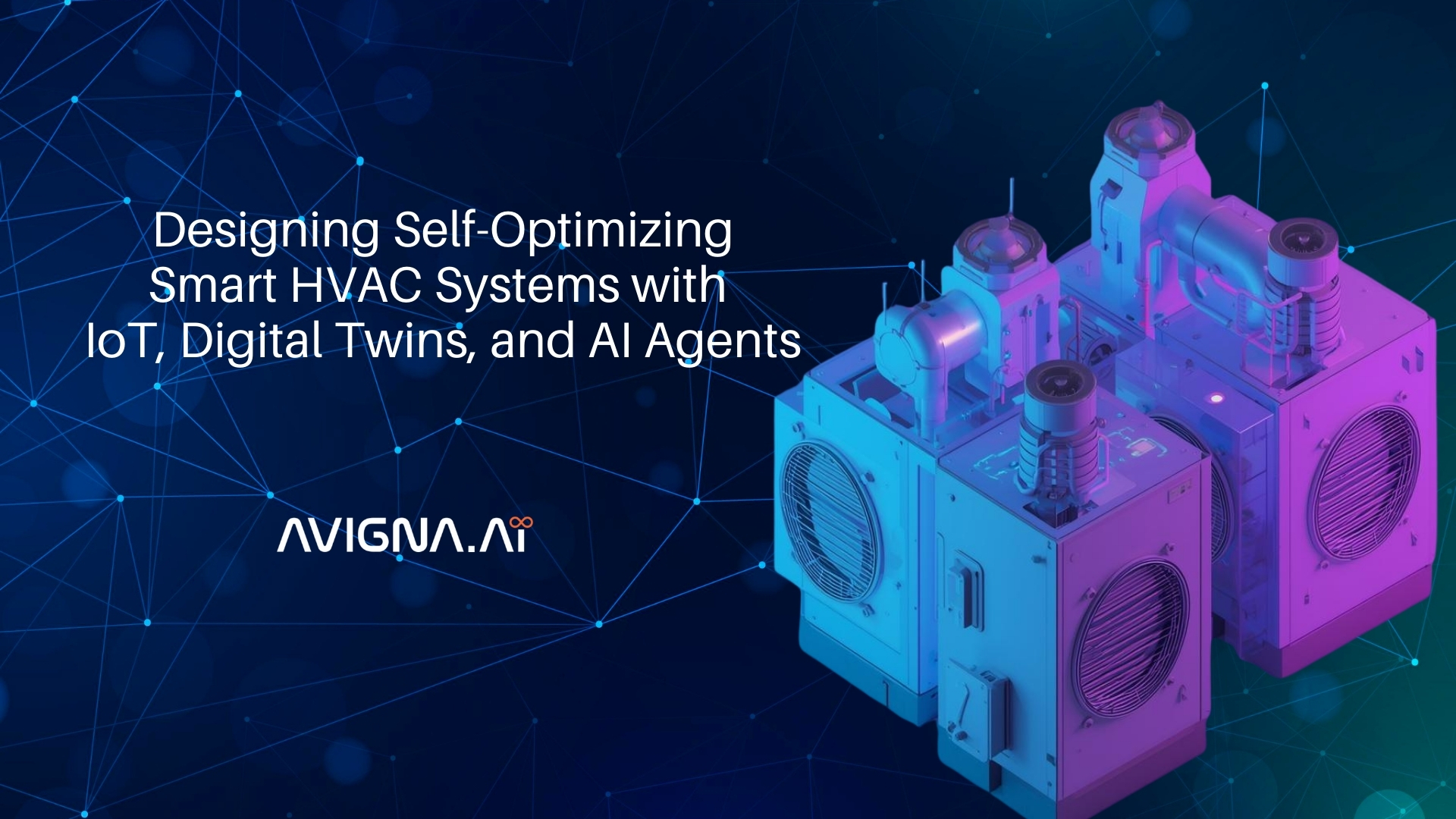
Designing Self-Optimizing Smart HVAC Systems with IoT, Digital Twins, and AI Agents
Over the last few years, I have walked through dozens of plants, hospitals, and commercial campuses that invested heavily in “smart HVAC”. Sensors everywhere. Dashboards everywhere. Alerts everywhere. Yet energy bills barely moved.
The problem was not technology. It was architecture.
Most deployments stopped at visibility. They collected data but never converted it into decisions. In my experience, HVAC only becomes efficient when it behaves like a cyber physical system, not a reporting system. That means closing the loop from sensing to prediction to optimization to automatic control.
This is the same logic that now runs modern factories and logistics networks. HVAC should be treated no differently.
The Industry 4.0 stack makes that practical.
Start with perception, but do not stop there
Instrumentation is the foundation. Without clean telemetry, everything else fails.
In mature facilities we typically deploy:
- temperature, humidity, CO?, airflow, and differential pressure sensors
- vibration and current sensors on compressors and fans
- power meters at chiller and plant level
- occupancy signals from access control or vision systems
- weather feeds for external load influence
This layer answers one question only: what is happening right now?
Many projects stop here. They build a dashboard and call it smart. A dashboard is useful for engineers. It does not optimize a system at 3:10 a.m. when load drops and two chillers could be shut down.

Add prediction, because operations are about the next hour
Once telemetry is reliable, the next step is forecasting.
HVAC decisions are sequential. You do not just react. You anticipate.
We apply machine learning models for:
- cooling and heating load forecasting
- occupancy prediction by zone
- equipment failure probability
- runtime degradation trends
- weather adjusted demand curves
With accurate forecasts, you stop firefighting. You schedule proactively.
For example, if tomorrow’s peak is predictable within a tight band, you can pre cool thermal mass, stagger starts, and avoid demand spikes. That alone can reduce peak penalties significantly.
Prediction converts raw IoT data into operational context.
Move to prescription, where real savings begin
This is the layer most organizations skip, and it is where the value actually lives.
Once you know what will happen, you must decide what to do.
HVAC plants are multi objective systems:
- minimize energy consumption
- maintain comfort bands
- extend equipment life
- reduce maintenance cost
- avoid peak tariffs
These objectives conflict. You cannot optimize them manually every five minutes.
This is where optimization algorithms and reinforcement learning matter.
We typically implement:
- optimal chiller sequencing
- pump and fan speed scheduling
- dynamic setpoint adjustment
- maintenance window planning
- energy aware dispatch during tariff changes
Instead of fixed rules, the system evaluates multiple scenarios and selects the best action under constraints.
At one industrial campus we replaced static sequencing with optimization based control. Nothing exotic. Just mathematics and good telemetry. Energy intensity dropped in the first quarter without any hardware changes.
Execute at the edge, not in a distant cloud
Control decisions must be local.
If actuation depends on a remote cloud round trip, latency and reliability become risks. Mechanical systems cannot wait.
We deploy edge gateways that:
- ingest local sensor streams
- run prediction models
- execute optimization policies
- send commands directly to PLCs and BMS controllers
This turns HVAC into a true cyber physical system. The plant senses, thinks, and acts on its own.
Cloud still has a role for training models and long term analytics. Real time control belongs close to the equipment.
Use digital twins to test before you touch the plant
Operations teams are cautious for good reason. Nobody wants experiments on live assets.
Digital twins remove that fear.
A calibrated building or plant model allows us to:
- simulate extreme heat days
- test alternative control policies
- evaluate energy and comfort tradeoffs
- validate maintenance strategies
We often discover that a policy that looks good on paper causes oscillations or comfort drift. The twin catches it before deployment.
This approach shortens commissioning cycles and builds trust with facility teams.
Where AI agents fit
I see increasing interest in AI agents. The term is overused, but the concept is simple.
An agent continuously:
- observes system state
- predicts near term outcomes
- evaluates multiple actions
- selects the best policy
- learns from results
In practice, this means your HVAC plant just became smart HVAC plant, adjusts itself every few minutes without waiting for a human to intervene.
During unexpected events, such as partial equipment failure or sudden occupancy spikes, the agent reschedules instantly.
In one hospital deployment, this capability prevented cascading overload when two air handling units went offline. The system redistributed airflow and maintained critical zones automatically. Staff did not notice. That is the standard we should aim for.

Measure outcomes, not features
We advise every client to track only a few hard metrics:
- kWh per ton of cooling
- peak demand charges
- comfort deviation hours
- mean time between failures
- maintenance cost per asset
If these do not improve, the system is not truly intelligent.
More sensors or prettier dashboards do not count as success.
How we approach projects now
Based on what we have seen across facilities, the sequence that works is disciplined:
- instrument correctly
- clean and standardize data
- deploy forecasting models
- introduce optimization
- move control to the edge
- validate with a digital twin
- scale gradually
Trying to jump straight to AI without this foundation usually leads to disappointment.
Closing thoughts
HVAC is one of the largest controllable energy loads in any facility. Yet it is still operated like a manual system with digital screens. We can do better.
When you treat HVAC as a connected, predictive, and autonomous system, we achieve smart HVAC and performance improves without expensive capital upgrades. The gains come from better decisions made consistently, not occasional human intervention.
If you are exploring modernization, start with one plant or one building. Instrument it fully. Add forecasting. Introduce optimization. Let the results speak.
We are always open to comparing notes and sharing what has worked in our deployments. Schedule a free consultation with us.